 Ghost Blogger
India has produced many writers. But only one of them had a doorbell that warned visitors: “Don’t ring unless you have an appointment.” Only one of them wrote his own obituary — as a joke — years before he died. And only one of them handed back one of India’s highest civilian awards simply because his conscience demanded it.
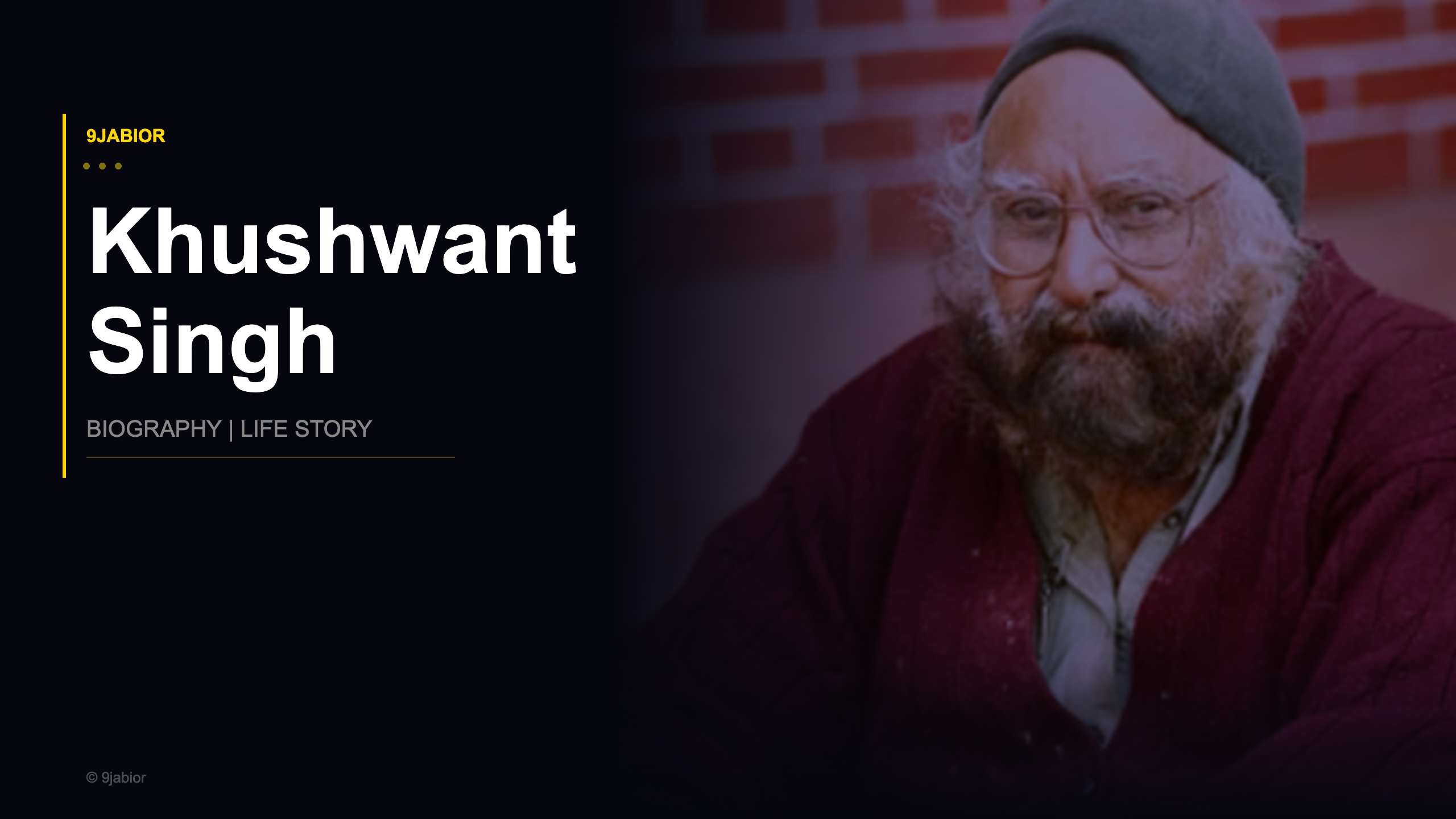
That man was Khushwant Singh.
If you’ve ever searched for the biography of Khushwant Singh, you already know the basics: he was a novelist, journalist, and lawyer who lived from 1915 to 2014. But that description is like calling the Taj Mahal a building. There was so much more going on beneath the surface. This article goes deeper — into the stories, the contradictions, the courage, and the remarkable life of a man who refused to pretend.
Who Was Khushwant Singh? A Quick Snapshot
Khushwant Singh was an Indian author, journalist, lawyer, diplomat, and politician — but those titles don’t begin to cover it. He’s best known for writing Train to Pakistan, a novel born out of the raw horror of India’s Partition in 1947. He edited some of India’s most influential magazines and newspapers. He served in parliament. He won the Padma Bhushan and then gave it back.
He was funny, provocative, deeply patriotic, and deeply honest. He’d call out hypocrisy whether it came from politicians, priests, or publishers. He outlived almost everyone who tried to silence him and kept writing until he was 98 years old.
He died on March 20, 2014, in New Delhi — but his voice is still very much alive.
The Roots That Made Him: Birth, Family, and Early Life in Hadali
His Father’s Extraordinary Legacy — The Man Who Helped Build Delhi
Khushwant Singh was born on February 2, 1915, in Hadali, a small village in the Khushab District of Punjab — a place that now sits inside Pakistan. He came from a wealthy Sikh family with a fascinating backstory of its own.
His father, Sir Sobha Singh, was no ordinary man. He was one of the most prominent builders of colonial India, responsible for constructing some of Delhi’s most iconic landmarks — including parts of India Gate, South Block, and Connaught Place. Locals called him “Adhi Dilli ka Malik” — the owner of half of Delhi. Khushwant grew up watching his father transform stone into monuments while quietly dreaming that he’d one day shape the world with words instead of bricks.
Sobha Singh also built Sujan Singh Park near Khan Market in New Delhi in 1945 — Delhi’s first residential apartment complex, named after his own father. It’s where Khushwant lived for most of his adult life, right until the end. There’s something poetic about that: the son of the man who built Delhi’s first modern apartments choosing to stay in that very building forever.
His mother was Veeran Bai, and his uncle Sardar Ujjal Singh later served as the Governor of Punjab and Tamil Nadu. The family was, in every sense of the word, connected — to wealth, to politics, and to the bones of the nation being built around them.
A Name Born from Teasing: The Story Behind “Khushwant”
Here’s something most people don’t know: Khushwant Singh wasn’t actually born with that name.
His grandmother named him Khushal Singh, which means “Prosperous Lion.” At home, they called him “Shalee.” But at school, the boys weren’t kind about it. They’d mock him with a Punjabi phrase — “Shalee Shoolee, Bagh dee Moolee” — which roughly translates to calling him the radish of some garden. Not exactly flattering.
So young Khushal decided to rebrand himself. He picked “Khushwant” because it rhymed with his elder brother Bhagwant’s name. He later admitted the new name was “self-manufactured and meaningless” — and he seemed absolutely fine with that. It suited him. He was always more interested in authenticity than prestige.
Growing Up in a Village That No Longer Belongs to India
Hadali left its mark on Khushwant in ways that never fully faded. His grandmother Lakshmi Devi was a constant presence in his childhood — a deeply religious woman who woke before dawn every day to finish her chores while saying her prayers. He’d later immortalize her in one of his most beloved short stories, The Portrait of a Lady, capturing her warmth, her simplicity, and the quiet sorrow of growing apart from someone you love.
After Partition, Hadali became part of Pakistan. The boy who grew up in its lanes became a man who spent decades writing about that very loss — of home, of belonging, of a Punjab that existed only in memory. When he died in 2014, part of his ashes were buried in Hadali. It was a final homecoming that the living man never got to experience.
School Days, Pranks, and the Spark of a Writer
Modern School Delhi: Where the Mischief Began
In 1920, five-year-old Khushwant Singh enrolled at Delhi Modern School, one of India’s first coeducational institutions. He stayed there until 1930 — a full decade that shaped his personality more than any classroom lesson.
By all accounts, he was not a model student. He was described as an “incorrigible prankster.” One story that stuck with him his whole life: he and his brothers once smuggled a cobra into school and presented it to their chemistry teacher. That incident, instead of getting buried in embarrassment, eventually found its way into his short story The Mark of Vishnu. Even as a kid, Khushwant was turning life into literature.
He wasn’t a standout academic. He did well only in English and geography. But Modern School planted something important in him — a love for English and Urdu poetry that never left. He’d carry verses around in his head the way other people carry songs.
Meeting Kaval Malik — A Childhood Friendship That Became Marriage
It was also at Modern School where he first met Kaval Malik, a girl one year his junior. They were just kids at the time — he was a prankster, she was quiet and studious. They’d eventually lose touch, cross paths again in London decades later, and fall in love properly. But it all started in those school corridors. Some things don’t rush.
Education Across Three Countries
From Lahore to London — The Making of a Lawyer
After Modern School, Khushwant’s educational journey took him across cities and continents. He studied Intermediate Arts at St. Stephen’s College in Delhi (1930–1932), then moved to Government College in Lahore, where he earned his BA in 1934 — with, as he put it himself, a “third-class degree.” He never pretended otherwise.
From Lahore, he crossed the world to King’s College London, where he pursued an LL.B. from the University of London, completing it in 1938. He was subsequently called to the bar at the Inner Temple in London. He had become, officially, a lawyer.
What His Law Degree Really Taught Him About Storytelling
London wasn’t just about law. It was in those years that he reconnected with Kaval Malik, who had moved there to study Montessori teaching. They married in 1939 in a quiet ceremony — only Chetan Anand and Iqbal Singh as guests. Muhammad Ali Jinnah, later the founder of Pakistan, also attended the formal service. Even Khushwant Singh’s wedding had historical footnotes.
More importantly, the courtroom sharpened his instincts. As a defense lawyer, he handled murder cases involving communities torn apart by religious and political violence. He saw what people were capable of under pressure. He understood human nature not in the abstract, but in the terrifying specific. That understanding fed every page he later wrote.
From Courtroom to Diplomatic Corridors
Eight Years as a Lawyer in Lahore
Khushwant began practicing law in 1939 at the Lahore High Court, working for eight years in chambers with some of the city’s sharpest legal minds. He handled defense cases, built relationships across communities, and watched pre-Partition India slowly unravel from the inside.
Joining the Indian Foreign Service After Independence
When India became independent in 1947, everything changed. The Partition shattered Punjab. Khushwant relocated his family to Delhi. And instead of returning to law, he joined the Indian Foreign Service — the diplomatic wing of the newly born nation.
His first posting was as Information Officer for the Government of India in Toronto, Canada. He then served as Press Attaché at the Indian High Commission, splitting his time between London and Ottawa for four years. These postings gave him a front-row seat to how the world saw India, and how India was still figuring out how to see itself.
It was during these diplomatic years that he began writing short stories. His first collection, The Mark of Vishnu and Other Stories, was published in London in 1950. The writer was awakening.
The Birth of a Writer — How Partition Cracked Open His Imagination
Witnessing the Bloodshed of 1947 First-Hand
Khushwant Singh didn’t just read about Partition in newspapers. He lived through it. He watched trains roll in carrying people — sometimes living, sometimes not. He heard Sikh men boasting about villages they’d massacred. He saw the sheer madness of what happens when religion and politics collide without mercy.
These weren’t stories to him. They were memories. And they burned.
Train to Pakistan: The Novel That Shocked the World
Published in 1956, Train to Pakistan became his most celebrated work — and for good reason. Set in the fictional village of Mano Majra along the India-Pakistan border in 1947, the novel doesn’t flinch. It portrays the chaos, the communal violence, and the impossible moral choices that ordinary people faced during one of history’s most devastating migrations.
What made it extraordinary wasn’t just the subject matter. It was the humanity Singh brought to both sides. His characters weren’t symbols or representatives of religions — they were people. Flawed, desperate, sometimes heroic, often cowardly. The novel earned international acclaim and was adapted into a film in 1998. Decades later, it remains the definitive fictional account of Partition in English.
His Other Major Books You Need to Know
Khushwant Singh didn’t stop with one masterpiece. He kept writing across genres and decades:
- I Shall Not Hear the Nightingale (1959) — A novel about a Sikh family caught between loyalty to the British and the independence movement, full of moral ambiguity.
- A History of the Sikhs (1963–1966) — A two-volume scholarly work considered the most authoritative English-language history of Sikhism. He researched original documents in Gurmukhi, Persian, and English. It remains a standard reference text.
- Delhi: A Novel (1990) — After 25 years of research, this ambitious novel weaves through Delhi’s entire history across centuries, blending fiction and fact with remarkable confidence.
- The Company of Women (1999) — Unapologetically bold, this novel explores male desire and post-divorce life. It sparked controversy and earned admiration in equal measure.
- Truth, Love and a Little Malice (2002) — His autobiography, written with the same sharp honesty he applied to everything else. He spared no one, including himself.
- The Good, The Bad and The Ridiculous (2013) — His final book, a sharp critique of organized religion in India. Published when he was 98. He retired from writing after this one.
He also translated Punjabi and Urdu texts into English — works by Amrita Pritam, Sikh scripture, and more. His translations opened a world of literature to readers who’d never otherwise have access to it. It’s a contribution that often gets lost in the noise of his fiction.
A Journalism Career Unlike Any Other
How He Transformed The Illustrated Weekly of India
In 1951, Khushwant joined All India Radio as a journalist. Between 1954 and 1956, he worked with UNESCO’s Department of Mass Communication in Paris. These weren’t detours from his real career — they were the training ground.
But his most dramatic editorial chapter began when he took over The Illustrated Weekly of India in 1969. At the time, it was a respectable but sleepy publication with a circulation of around 65,000. When he left nine years later, that number had crossed 400,000. He did it by doing something radical: he tackled subjects that Indian publications avoided. Sex. Politics. Religion. Hypocrisy. He treated readers like adults who could handle the truth, and readers responded.
On July 25, 1978, a week before his scheduled retirement, the management asked him to leave immediately. A new editor was installed the same day. The circulation collapsed afterward. The numbers told the story clearly.
His Legendary Column “With Malice Towards One and All”
His weekly column, which ran in Hindustan Times and later in several national dailies, became one of the most-read features in Indian journalism. The title was a deliberate play on Abraham Lincoln’s “With malice toward none” — and the reversal was entirely intentional. Singh had malice toward everyone who deserved it, and he wasn’t shy about saying so.
The column ran for decades. It covered politics, religion, literature, history, and personal observation in language that was always clear, always sharp, and never dull. He had a gift for making complex ideas accessible without dumbing them down. That’s rarer than it sounds.
His Tenure at Hindustan Times and the Controversy That Ended It
He served as editor of Hindustan Times from 1980 to 1983 — an appointment that came through Indira Gandhi’s personal recommendation. His editorial tenure there was marked by the same directness that had defined his entire career. But political pressures and management conflicts eventually ended his run there too.
He also founded and edited Yojana, a government journal, and served as editor-in-chief of The National Herald. By any measure, his journalism career touched the entire landscape of Indian media over five decades.
Khushwant Singh and Politics: A Love-Hate Story
His Support for Indira Gandhi and the Emergency Era
Khushwant Singh was a vocal supporter of Indira Gandhi for much of his political life. When she declared the Emergency in 1975 — suspending civil liberties and press freedom across India — he did not publicly oppose her the way many journalists did. It was a position that cost him credibility with some of his peers and readers, and it’s one he addressed honestly in his autobiography later.
He wasn’t naive about it. He understood the criticism. But he also believed in Indira Gandhi’s vision for India, even when he disagreed with her methods. It’s one of the fascinating contradictions of a man who spent his life demanding honesty from others.
Why He Returned the Padma Bhushan in 1984 — And What It Cost Him
In 1974, the President of India awarded Khushwant Singh the Padma Bhushan — the country’s third-highest civilian honour. It was a proud moment for a man who had served his country across law, diplomacy, journalism, and literature.
Ten years later, he gave it back.
In June 1984, the Indian Army launched Operation Blue Star — a military assault on the Golden Temple in Amritsar, Sikhism’s holiest shrine, to flush out militants who had occupied it. The operation killed hundreds of people, including many civilians who had nothing to do with the militants. Sikh sentiment across India and the world was devastated.
Khushwant Singh, despite his long association with Indira Gandhi’s government, returned his Padma Bhushan. It was a statement that came at personal and political cost. He was a secular man who didn’t wear his Sikh identity loudly, but when his community’s most sacred space was violated, he made his position clear.
It wasn’t a gesture. It was a conviction.
Member of Rajya Sabha: 1980 to 1986
From 1980 to 1986, Khushwant Singh served as a Member of Parliament in the Rajya Sabha, the upper house of India’s Parliament. He was nominated — not elected — and used the platform to speak on issues of press freedom, minority rights, and social justice. His presence in parliament was, like everything else about him, unconventional.
His Views on God, Religion, and Death
The Agnostic Who Never Apologized for It
Khushwant Singh was a self-declared agnostic, and he said so in the clearest possible terms — including in the title of his 2011 book, Agnostic Khushwant: There Is No God. He was particularly critical of organized religion in all its forms — not just one faith, but the institutional machinery of all of them.
He once said something that cut to the core of his philosophy: “One can be a saintly person without believing in God and a detestable villain believing in him.” He also declared, “In my personalised religion, there is no God.”
Coming from a Sikh family in a deeply religious country, this was not a casual observation. It was a position he held with the same stubbornness he brought to everything he believed. He didn’t soften it for audiences. He didn’t hedge it in interviews. He just said it clearly and let people respond however they chose.
He also had a clear view of death itself. He didn’t believe in rebirth, reincarnation, heaven, or hell. He accepted death as final, and he wrote about it with the same frankness he brought to every other taboo subject.
His Famous Self-Written Epitaph
Khushwant Singh wrote his own epitaph long before he needed one. It read:
Here lies one who spared neither man nor God; Waste not your tears on him, he was a sod; Writing nasty things he regarded as great fun; Thank the Lord he is dead, this son of a gun.
It’s probably the most honest thing ever written on a gravestone — and it was written by the man himself, with obvious delight. That’s Khushwant Singh in four lines: irreverent, self-aware, funny, and completely unafraid.
The Side of Khushwant Singh Nobody Talks About
The Man Who Invented Santa and Banta Jokes
Here’s something that will surprise you. Those Santa and Banta jokes you grew up hearing — the ones that poke fun at Sardar stereotypes in the most affectionate way possible? Khushwant Singh started writing them in the 1980s, originally just for fun. The characters took on a life of their own and became embedded in Indian pop culture. The man who wrote serious novels about Partition and Sikh history also gave India its most beloved joke franchise. Only in Khushwant Singh’s world would that make perfect sense.
His Daily Routine: Early Mornings, Scotch Whisky, and Zero Excuses
Khushwant was famously disciplined about his writing. He woke up early every morning, wrote for several hours, and treated the craft as a job — not a mood. He was known to say: “Get up early, write, and don’t stop.” No waiting for inspiration. No excuses. Just work.
He also famously loved Scotch whisky and made no apologies for it, often referencing his drinking habits in his writing with obvious fondness. He had a clear sense of what he enjoyed and saw no reason to pretend otherwise. It fit perfectly with the rest of his personality.
The Doorbell That Said “Don’t Ring Unless You Have an Appointment”
His apartment at Sujan Singh Park was legendary among Delhi’s literary circles. The doorbell — which chimed with the message “Don’t ring unless you have an appointment” — became one of the most talked-about details in stories about him. He guarded his time fiercely. Visits were by invitation only. But when you did get in, people said, he was warm, curious, funny, and completely present. The gruffness was the door. The man inside was something else entirely.
He also had a deep love for Kasauli, a quiet hill station in Himachal Pradesh, where he spent time away from Delhi’s chaos. Today, an annual literary festival — the Khushwant Singh Literary Festival — is held there in his memory, celebrating the same spirit of honest, fearless writing that he championed his whole life.
Awards, Honours, and Recognition
Despite — or perhaps because of — his willingness to say uncomfortable things, Khushwant Singh collected significant recognition over his career:
- Padma Bhushan (1974) — Awarded by the President of India; returned in 1984 in protest against Operation Blue Star.
- Honest Man of the Year Award (2000) — Given by Sulabh International for his courage and sincerity in writing.
- Punjab Rattan Award (2006) — Awarded by the Government of Punjab.
- Padma Vibhushan (2007) — India’s second-highest civilian honour, awarded for distinguished service to the nation.
- Sahitya Akademi Fellowship (2010) — One of India’s highest literary recognitions.
- All-India Minorities Forum Annual Fellowship Award (2012)
- Tata Literature Live! Lifetime Achievement Award (2013)
- Fellowship of King’s College London (2014) — Awarded in the year of his death.
- Limca Book of Records (2016, posthumously) — A tribute to his extraordinary life and work.
His Lasting Legacy — What He Means to Indian Literature Today
The Khushwant Singh Literary Festival in Kasauli
Every year, writers, readers, journalists, and thinkers gather in Kasauli to celebrate the Khushwant Singh Literary Festival. It’s held in the hill station he loved — a place where he did some of his clearest thinking. The festival brings together voices from across India and the world, and it explicitly carries forward his belief that good writing requires honesty above everything else.
It’s a fitting tribute. He wasn’t interested in literary awards as much as he was interested in literary courage.
Why Young Writers Still Read Him
Khushwant Singh matters to contemporary Indian writing for several reasons. First, he demonstrated that English-language literature from India didn’t have to be precious or obscure to be powerful. His prose was clear and direct — anyone could read it, and that was entirely intentional.
Second, he modeled something rare: the writer as public intellectual who doesn’t retreat into academia. He stayed in the newspaper. He kept the column running. He engaged with politics, religion, and current events decades after he could have comfortably retired into respectability.
Third — and perhaps most importantly — he showed that being Indian and secular, being Sikh and agnostic, being patriotic and critical of the government, were not contradictions. They were all part of the same honest reckoning with a complicated country he loved.
When he died on March 20, 2014, at the age of 99, India’s President, Vice President, and Prime Minister all mourned his passing. His ashes were carried to Hadali in Pakistan — the village where it all began — and buried in the school compound with a plaque that read:
“This is where my roots are. I have nourished them with tears of nostalgia.”
He came home. Just a little late.
FAQ — Biography of Khushwant Singh
What is Khushwant Singh famous for? Khushwant Singh is most famous for writing Train to Pakistan (1956), a landmark novel about India’s Partition. He’s also celebrated for his journalism, his satirical column “With Malice Towards One and All,” his two-volume history of Sikhism, and his fearless, opinionated public voice.
When was Khushwant Singh born and when did he die? He was born on February 2, 1915, in Hadali, Punjab (now in Pakistan), and he died on March 20, 2014, in New Delhi at the age of 99.
Why did Khushwant Singh return the Padma Bhushan? He returned the Padma Bhushan in 1984 to protest Operation Blue Star — the Indian Army’s military assault on the Golden Temple in Amritsar, Sikhism’s holiest shrine. He felt the operation was a violation he could not remain silent about.
Who was Khushwant Singh’s wife? He married Kaval Malik in 1939 after reconnecting with her in London. She was his childhood friend from Modern School in Delhi. She predeceased him in 2001. They had two children — a son, Rahul Singh, and a daughter, Mala Singh.
What are Khushwant Singh’s most important books? His most significant works include Train to Pakistan (1956), A History of the Sikhs (1963–66), I Shall Not Hear the Nightingale (1959), Delhi: A Novel (1990), The Company of Women (1999), his autobiography Truth, Love and a Little Malice (2002), and his final book The Good, The Bad and The Ridiculous (2013).
Was Khushwant Singh religious? No. He was a self-declared agnostic who was particularly critical of organized religion. He even titled a 2011 book Agnostic Khushwant: There Is No God. Born into a Sikh family, he maintained his cultural identity while firmly rejecting institutional religion in all its forms.
What was Khushwant Singh’s writing style like? His style was direct, clear, and often laced with sharp wit and satire. He avoided flowery language and wrote in a way that was accessible to a wide audience. He blended humor with serious social commentary and was never afraid to address taboo subjects — sex, religion, death, and politics — head-on.
What is Khushwant Singh’s literary legacy? He’s considered one of the foundational figures of post-Independence Indian literature in English. His influence extends across fiction, journalism, and public discourse. The Khushwant Singh Literary Festival in Kasauli continues in his memory, and his books remain widely read and taught across India and internationally.

 Ghost Blogger
 Admin
Admin