 Ghost Blogger
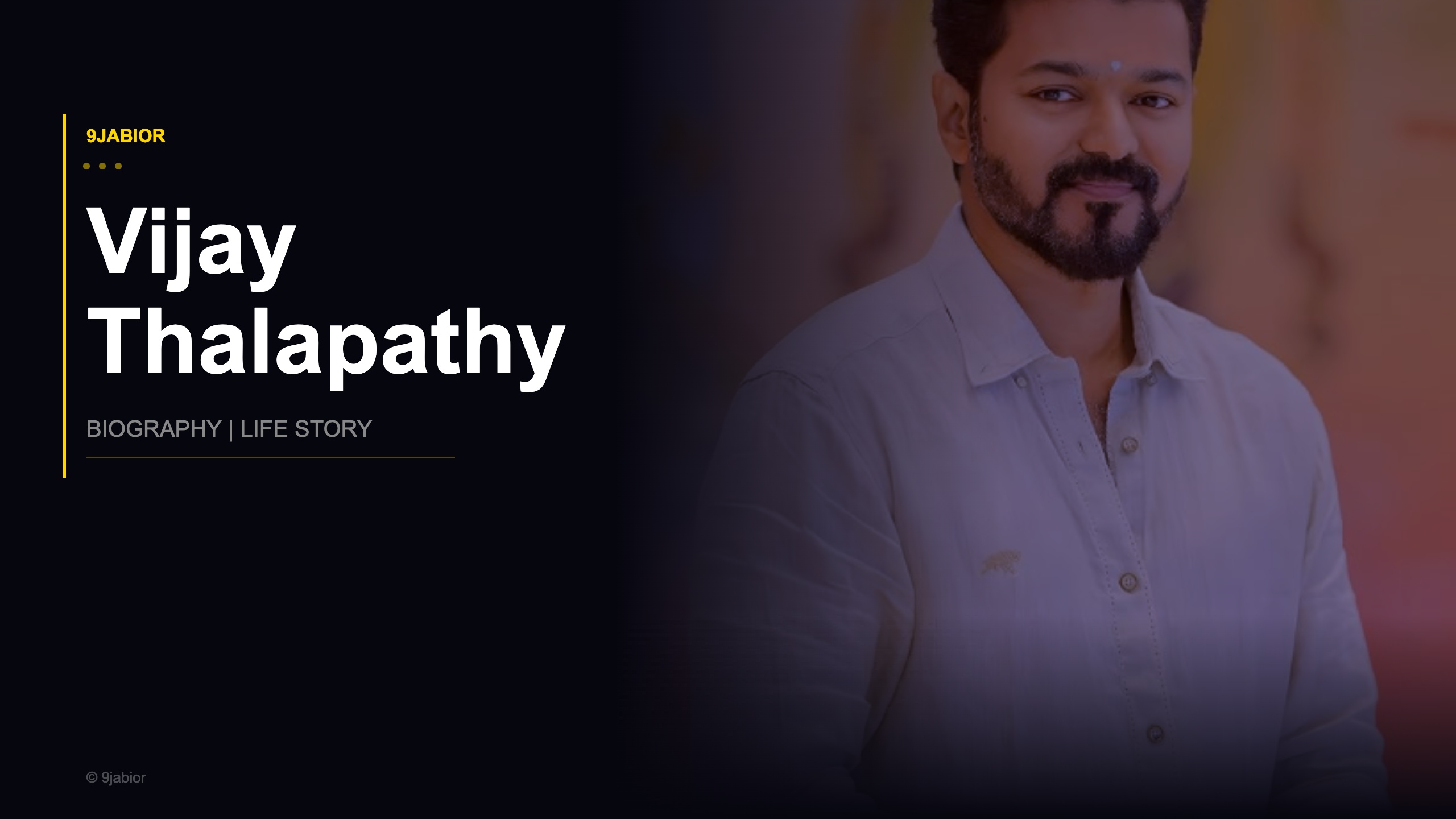
Let’s be honest — if you’ve ever watched a Tamil film, you’ve felt the energy. That electric moment when the hero walks in, the music swells, and the audience loses its mind. For millions of fans across India and beyond, that moment belongs to one man: Vijay Thalapathy Biography.
But Vijay isn’t just an actor. He’s a singer, a philanthropist, a father, and now — a politician. His story isn’t a straight-line success story. It’s got real lows, bitter failures, quiet sacrifices, and a deeply personal journey that most biopages barely scratch the surface of. This is the complete Vijay Thalapathy biography — told the way it deserves to be.
Who Is Thalapathy Vijay? A Quick Snapshot
Full Name: Joseph Vijay Chandrasekhar Date of Birth: June 22, 1974 Birthplace: Madras (now Chennai), Tamil Nadu, India Profession: Actor, Playback Singer, Politician, Philanthropist Known As: Thalapathy Vijay Political Party: Tamilaga Vettri Kazhagam (TVK) Net Worth (as of 2025): Approx. ₹600–625 crore
He’s acted in 69 films as a lead. He’s one of the highest-paid actors on the planet. And in February 2024, he walked away from all of it to change the political landscape of Tamil Nadu. That’s who Thalapathy Vijay is.
The Story Behind the Name “Thalapathy”
You’ll hear it everywhere. Spray-painted on walls. Chanted in theaters. Printed on banners stretching the length of a street. Thalapathy.
In Tamil, the word means “Commander” — more specifically, a military leader who leads from the front. It’s not a nickname he gave himself. Tamil audiences handed it to him organically, recognizing something in his screen presence that felt authoritative, powerful, and deeply connected to the ordinary person’s aspirations.
He was first called “Ilaya Thalapathy” — meaning Young Commander — in the mid-1990s, when he was still building his image. Over time, as he grew into his mass hero persona, the “Ilaya” was quietly dropped. By the time Mersal released in 2017, he had officially claimed the title in full. One word. No qualifiers.
Early Life: Born into Cinema, Raised by Passion
Vijay entered this world on June 22, 1974, in Madras — a city that was already the heartbeat of South Indian cinema. His family wasn’t just adjacent to the film industry. They were embedded in it.
His father, S. A. Chandrasekhar, is a well-known Tamil film director. His mother, Shoba Chandrasekhar, is a playback singer. So growing up, Vijay didn’t just watch movies — he lived inside the making of them.
But there’s a part of this story that doesn’t get told enough. Vijay had a younger sister, Vidhya, who passed away when she was just two years old. That loss left a mark on the family. Years later, when Vijay set up his own production house, he named it V.V Productions — a quiet, permanent tribute to his late sister. It’s a detail that says a lot about who he really is beneath the star persona.
Education and the Path to Stardom
Vijay attended Fathima Matriculation School in Kodambakkam for his early years, then moved to Balalok School in Virugambakkam. He later enrolled in Loyola College, Chennai, where he pursued a degree in visual communication — a program that attracted several people who’d go on to become big names in Tamil cinema.
It’s at Loyola that Vijay crossed paths with people like Suriya, Yuvan Shankar Raja, and Vishnuvardhan — future actors and composers who’d all leave their mark on the industry. They were classmates before they were colleagues.
Vijay eventually dropped out of college to focus entirely on acting. At the time, it might’ve seemed like a gamble. In hindsight, it was the clearest decision he ever made.
The Child Artist Years Nobody Talks About
Most people know Vijay started young. But not everyone knows just how early — or how meaningful that beginning was.
In 1984, when Vijay was just 10 years old, he appeared as a child artist in the Tamil film Vetri, produced by his father. That was his first on-screen moment. But what’s even more fascinating is that, during this same period, he also appeared as a child artist in a film featuring Rajinikanth — an actor he’s openly called his biggest inspiration.
Think about that. The boy who would one day become Tamil cinema’s Commander once stood on the same set as the man he idolized. Vijay has said that watching Rajinikanth work lit something in him that never went out.
The Lead Debut That Almost Ended Everything (1992–1995)
Vijay made his debut as a lead actor in 1992 with Naalaiya Theerpu, directed by his father. It didn’t go well.
The film flopped at the box office. Critics were unkind — some specifically took shots at his looks and his performance. For a young man putting himself out there for the first time, that kind of reception is brutal. Most people fold under that kind of pressure.
Vijay didn’t.
His father pivoted quickly, casting Vijay alongside Vijayakanth — a well-established hero — in Senthoorapandi (1993). The film was a hit, and it gave Vijay his first real taste of public acceptance. By 1994, Rasigan was running for 175 days in theaters. By 1995, Deva had completed a 100-day run. The comeback was real.
Finding His Voice: The Breakout Era (1996–2002)
If there’s one film Vijay himself credits as his true breakthrough, it’s Poove Unakkaga (1996), directed by Vikraman. It connected with audiences on an emotional level that his earlier films hadn’t quite managed. From that point forward, he was no longer just the director’s son trying to make it — he was a leading man in his own right.
1997 was particularly big. Kadhalukku Mariyadhai earned him his first Tamil Nadu State Film Award for Best Actor, along with the prestigious Kalaimaamani honor from the Government of Tamil Nadu. He was 23 years old.
Through 1999 and 2000, films like Thulladha Manamum Thullum, Kushi, and Priyamaanavale cemented his image as the go-to romantic hero of Tamil cinema. He had the moves, the charm, the music — and fans couldn’t get enough.
The Thirumalai Moment: How Vijay Became an Action Star
Here’s a pivot point that genuinely reshaped Tamil cinema. In 2003, Vijay starred in Thirumalai. Up until that point, he’d been the romantic lead — charming, a bit comical, lovable. Thirumalai changed all of that.
The film introduced a grittier, more street-smart version of Vijay. He was tougher. Angrier. More complex. Audiences responded with overwhelming enthusiasm. The “lover boy” image started fading, replaced by something that felt rawer and more exciting.
Then came 2004. And Ghilli.
Director S. Dharani’s Ghilli wasn’t just a hit — it was a landmark. It became the first Tamil film in history to gross over ₹50 crore at the domestic box office, shattering the record for first-week audiences that had stood since M. G. Ramachandran’s era. In one stroke, Vijay didn’t just lead the film — he led Tamil cinema into a new commercial era.
The Blockbuster Machine: Decade of Dominance (2005–2014)
What followed was a relentless run of commercially successful films. Thirupaachi, Pokkiri, Vel, Villu, Vettaikaaran — each one reinforcing Vijay’s place at the very top of the industry.
But it wasn’t just entertainment. Vijay started using his characters to say something. In Thuppakki (2012), his character fought against urban terrorism. Kaththi (2014) took on corporate exploitation of farmers. Thalaivaa (2013) dealt with political corruption and community leadership. These weren’t just masala films — they were Vijay holding up a mirror to real issues, reaching millions of people who might never engage with those topics otherwise.
He was earning audience love and trust simultaneously. That’s not an easy balance to strike.
The New Wave Era: Master, Beast, Leo, and GOAT (2015–2024)
After 2015, Vijay shifted gears again. He worked with some of Tamil cinema’s most celebrated directors — Atlee, Lokesh Kanagaraj, Venkat Prabhu — and the results were extraordinary.
Master (2021), released during the pandemic, still managed to make over ₹200 crore. Beast (2022) crossed ₹300 crore and became one of Netflix’s most-viewed Tamil films globally that year. Varisu (2023) grossed ₹300 crore. Then Leo arrived.
Leo (2023), directed by Lokesh Kanagaraj, crossed ₹600 crore — making it one of the highest-grossing Indian films of that year. Vijay played a character with a dangerous secret past, and the performance generated a different kind of conversation around his range as an actor.
The Greatest of All Time (GOAT, 2024) followed, a sci-fi action film that earned ₹450 crore theatrically before heading to Netflix. For it, Vijay reportedly earned over ₹200 crore — putting him in the same earnings bracket as some of Hollywood’s biggest names. When one outlet noted that his 2024 payday exceeded Robert Downey Jr.’s, it wasn’t hyperbole. It was data.
His 69th and final film as a lead actor — Jana Nayagan — was released in 2026, with reports suggesting his fee was in excess of ₹275 crore.
Vijay as a Playback Singer: The Voice Behind the Superstar
Here’s something most casual fans don’t fully appreciate. Vijay isn’t just acting in those songs — he’s singing many of them.
Over the course of his career, he’s lent his voice to more than 30 songs. Tracks like Verithanam from Bigil and Selfie Pulla from Kaththi became genuine chartbusters — not because of novelty, but because he can actually sing. His voice has a warmth and an energy that suits his on-screen personality perfectly.
By 2019, he had completed 25 years as a playback singer. That’s a parallel career that most people overlook entirely when discussing his legacy.
The Man Behind the Screen: Personal Life and Family
Vijay married Sangeetha Sornalingam on August 25, 1999, in a ceremony that beautifully blended Hindu and Christian traditions — reflecting his own family’s mixed religious background (his father is Christian, his mother Hindu). Sangeetha, a Sri Lankan Tamil based in London, was reportedly a devoted fan of Vijay before they met.
They have two children together: son Jason Sanjay, born on August 26, 2000 in London, and daughter Divya Saasha, born on September 9, 2005 in Chennai.
What’s a lovely detail — and one that few articles bother to mention — is that both children have appeared in their father’s films. Jason had a small role in Vettaikaaran, and Divya appeared in Theri. They didn’t make headlines. They just showed up quietly, did their bit, and left. Exactly like their father handles most personal things: without a fuss.
Vijay’s Quiet Side: Philanthropy, Charity, and Real-Life Values
Vijay’s charitable work has never been his PR strategy. He’s known for showing up where it matters — in disaster relief efforts, in education funding, in community welfare — without grand announcements.
In 2009, he formally launched Vijay Makkal Iyakkam (VMI), a fan-turned-welfare organization that expanded over time into genuine social impact work. VMI members eventually entered local body elections in Tamil Nadu in 2021, winning 115 out of 169 contested seats — a staggering success for what many dismissed as a fan club.
On his birthdays, don’t expect parties. Vijay has made it a practice to skip the celebrations and redirect attention to charitable causes. He’s a teetotaller. He’s low-key about his personal life. For someone of his magnitude, that restraint is actually quite remarkable.
There was also the 2015 income tax raid — a search at his residence that led to the discovery of additional undisclosed income. Vijay paid the tax on the disclosed amount promptly. The department later imposed a penalty, which he contested. It’s a messy chapter, but it’s part of the record.
From Silver Screen to Political Stage: Vijay’s Entry into Politics
On February 2, 2024, Vijay made an announcement that shook Tamil Nadu: he was forming a political party and retiring from films after one final role.
The party — Tamilaga Vettri Kazhagam, or TVK — translates to “Tamil Nadu Victory Party.” Its foundational ideology is striking in how clearly it positions itself. TVK draws inspiration from reformist thinkers like Periyar and B. R. Ambedkar. It openly rejects casteism, dynastic politics, corruption, and communalism. It promises transparent, accountable governance rooted in social justice.
The party was officially registered with the Election Commission of India on September 8, 2024.
For the 2026 Tamil Nadu Assembly elections, Vijay announced he’d personally contest from the Perambur and Tiruchirappalli (East) constituencies. This isn’t a ceremonial entry into politics — he’s going head-to-head in real battles, challenging a political landscape dominated for decades by the DMK and AIADMK.
Can a movie star break a political duopoly that’s been in place for generations? Tamil Nadu is watching.
Vijay Thalapathy Net Worth and Earnings
As of 2025, Vijay’s estimated net worth sits between ₹600 crore and ₹625 crore — approximately US$66–70 million. That figure comes from decades of film fees, brand endorsements, and business interests.
His per-film earnings tell the story of his rise:
- Beast (2022): Approx. ₹100 crore fee
- Varisu (2023): Approx. ₹120–150 crore fee
- The Greatest of All Time (2024): Approx. ₹200 crore fee
- Jana Nayagan (2026): Reported fee exceeding ₹275 crore
For context, ₹275 crore is roughly $33 million for a single film — a figure that puts him comfortably in the conversation with global entertainment’s biggest earners.
Awards, Honors, and Records That Define His Legacy
Vijay’s awards shelf is substantial. Here are the highlights:
- Tamil Nadu State Film Award for Best Actor (multiple wins)
- Kalaimaamani Award – Government of Tamil Nadu (1998)
- Honorary Doctorate – Dr. M.G.R. Educational and Research Institute (2007)
- Eight Vijay Awards (Star India)
- SIIMA Award
- Best International Actor – International Achievement Recognition Awards (2018, for Mersal)
- Forbes India Celebrity 100 – featured multiple times between 2012 and 2019, peaking at #26 in 2018
- Eastern Eye Magazine – ranked #8 among top global celebrities in Asia (2023), the only Tamil actor on the list
Beyond individual awards, his box office records speak loudly. He introduced the ₹50 crore club to Tamil cinema. He’s delivered multiple ₹100 crore, ₹200 crore, and ₹600 crore films. He’s on record as one of the most commercially successful actors in Indian film history.
Why Vijay’s Fan Following Is Unlike Any Other
You’ve got to understand the scale of what we’re talking about. Vijay’s fanbase doesn’t just watch his movies — they experience them as events.
When a Vijay film releases, theaters are draped in banners. Fans perform puja — religious offerings — before the first screening. Drums play. Garlands are thrown. Milk is poured. It’s not a premiere. It’s closer to a festival.
In 2019, a wax figure of Vijay was unveiled at a museum in Kanyakumari — one of only a handful of Tamil actors to receive that honor. In 2021, he was the most tweeted-about actor in South India. In 2023, Eastern Eye placed him among the top 10 global celebrities in Asia, alongside major Bollywood names.
His fans aren’t just watching. They’re belonging to something.
Frequently Asked Questions About Vijay Thalapathy
What is Thalapathy Vijay’s real name? His full name is Joseph Vijay Chandrasekhar. He’s known professionally simply as Vijay, and by his fans as Thalapathy.
What does the name “Thalapathy” mean? It’s a Tamil word meaning “Commander” or military leader. It was first given to him by fans during his rise in the late 1990s and is now an inseparable part of his identity.
Who is Vijay’s wife? Vijay is married to Sangeetha Sornalingam, a Sri Lankan Tamil. They married on August 25, 1999, and have two children — Jason Sanjay and Divya Saasha.
What is Vijay Thalapathy’s net worth in 2025? His net worth is estimated at approximately ₹600–625 crore (around US$66–70 million), making him one of the highest-paid actors in India.
Is Vijay a Hindu or Christian? Vijay comes from a mixed-faith family — his father is Christian and his mother is Hindu. His own religious identity has been kept largely private.
What is Vijay’s political party? Vijay founded Tamilaga Vettri Kazhagam (TVK) on February 2, 2024. The party is secular, anti-caste, and has contested the 2026 Tamil Nadu Assembly elections.
What was Vijay’s final film? Jana Nayagan, his 69th film as lead actor, released in 2026. It was his last film before his full transition into politics.
Has Vijay won any government awards? Yes. He received the Kalaimaamani Award from the Government of Tamil Nadu in 1998 and an honorary doctorate in 2007 from the Dr. M.G.R. Educational and Research Institute.
Final Thoughts: What Thalapathy Vijay Means to Tamil Culture
When you look at the full arc of Vijay’s life — the child artist who almost gave up, the romantic hero who reinvented himself, the blockbuster machine who used cinema as social commentary, the philanthropist who gave quietly, and the politician now stepping into the most consequential role of his life — you see something rare.
He’s not just famous. He’s meaningful.
Tamil cinema has produced many stars. But Thalapathy Vijay represents something beyond stardom. He’s become a symbol of possibility — for the young kid in a small town, for the person who believes cinema can actually say something true, for the voter who wants something different from their leaders.
Whether TVK rewrites Tamil Nadu’s political story or not, one thing is already settled: Vijay Thalapathy has lived a life worth telling. And this, in all its fullness, is that story.


 Ghost Blogger

 Admin
Admin