 Ghost Blogger
There’s a photo of Christina Koch floating inside NASA’s Orion spacecraft, her hair pulled into braids, Earth glowing enormous and impossibly blue in the window behind her. She posted it to Instagram with a simple caption: “First braids to leave Earth orbit.”
That one line says everything about Christina Koch. She’s accomplished things no woman has ever done before, broken records that stood for decades, and done all of it while staying completely, refreshingly human.
This is the full Christina Koch biography — from a little girl staring at the stars in North Carolina, to the first woman to journey around the Moon.
Who Is Christina Koch?
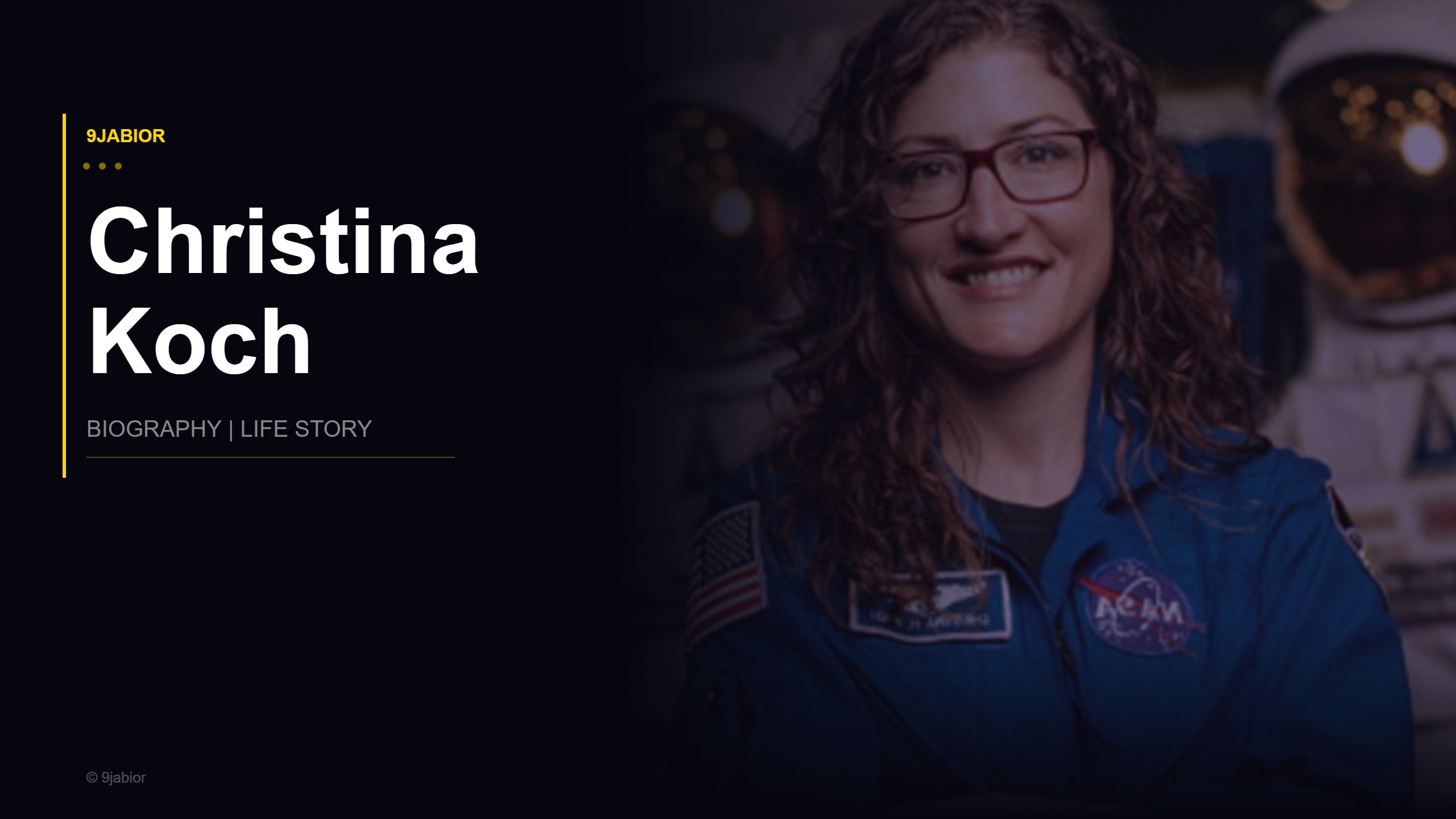
Christina Hammock Koch is an American engineer and NASA astronaut. Born on January 29, 1979, she holds the record for the longest single spaceflight by a woman (328 consecutive days in space), was part of the first all-female spacewalk in history, and most recently became the first woman to travel beyond low Earth orbit when she flew around the Moon on the Artemis II mission in April 2026.
She’s also a former Antarctic researcher, an electrical engineer, a rock climber, a surfer, and someone who once fixed a broken toilet in deep space. But we’ll get to that.
Quick Facts About Christina Koch
- Full name: Christina Hammock Koch (née Hammock)
- Date of birth: January 29, 1979
- Birthplace: Grand Rapids, Michigan
- Raised in: Jacksonville, North Carolina
- Education: BS in Electrical Engineering and Physics, MS in Electrical Engineering — NC State University
- NASA Selection: 2013 (Astronaut Group 21)
- Days in space (ISS): 328 consecutive days
- Spacewalks: 6 total, 42+ hours outside the ISS
- Artemis II: Mission Specialist 1, April 1–10, 2026
- Spouse: Robert Koch
- Pronounciation of last name: “Cook”
Why Her Story Matters Right Now
Christina Koch became the first woman in history to orbit the Moon on April 6, 2026. That’s not a small thing. The last time humans went near the Moon was 1972 — more than 50 years ago — and every single person on those Apollo missions was a man. The Artemis II crew didn’t just make history. They reset expectations for who gets to explore the universe.
Early Life and Childhood — A Girl Who Looked Up
Born in Michigan, Raised in North Carolina
Christina Hammock was born in Grand Rapids, Michigan, but she didn’t stay there long. Her family moved to Jacksonville, North Carolina, where she spent most of her childhood. Summers, though, belonged to her grandparents’ farm in Michigan — wide open land, physical work, and clear skies at night.
Jacksonville is a military town, not exactly the first place you’d expect to produce a record-breaking astronaut. But Christina never let geography limit her imagination.
Summers on the Farm and Stargazing Nights
Growing up between Jacksonville and the Michigan farm instilled something in her. She’s talked about how much she loved things that made her feel small — looking up at the night sky through pine tree branches, feeling the scale of the universe pressing down on her in the best possible way.
She told NASA before the Artemis II launch: “I always say to people, ‘Do what scares you.'” That philosophy started forming young.
By kindergarten, she was already telling her teachers she wanted to be an astronaut. Not a princess. Not a pop star. An astronaut. And unlike a lot of childhood dreams, this one never wavered.
How Space Camp and Rocket Club Shaped Her Dream
Christina didn’t just dream about space — she chased it. She attended Space Camp in Huntsville, Alabama, multiple times as a kid. She joined her school’s Rocket Club. She made a trip to the Kennedy Space Center in Florida. Every experience stacked on top of the last, building a foundation before she was even in high school.
That kind of intentional pursuit of a dream, starting in childhood, is what makes her story genuinely inspiring rather than just impressive.
Education — Building the Skills to Reach Space
High School at North Carolina School of Science and Mathematics
Christina didn’t attend an ordinary high school. She transferred to the North Carolina School of Science and Mathematics in Durham, a residential public high school designed for the state’s most academically gifted students. She graduated in 1997.
Before that, she also attended White Oak High School in Jacksonville. The decision to push herself into a more rigorous environment shows the kind of self-directed ambition that would define her entire career.
Three Degrees from NC State University
At North Carolina State University in Raleigh, Christina was one of very few women in her science classes. She didn’t let that stop her. She earned:
- Bachelor of Science in Electrical Engineering (2001)
- Bachelor of Science in Physics (2001)
- Master of Science in Electrical Engineering (2002)
Three degrees. Two of which were funded in part by scholarships from the Astronaut Scholarship Foundation — which, in hindsight, feels like the universe winking at her.
She later received an honorary Doctor of Sciences degree from NC State in December 2020, when she gave the address at the university’s fall commencement ceremony.
The Exchange Program in Ghana That Broadened Her View
Here’s a detail that almost no biography about Christina Koch mentions: in 1999, while at NC State, she participated in an exchange program at the University of Ghana in Legon, where she studied astrophysics.
That experience — living and studying on an entirely different continent, in a completely different cultural environment — isn’t incidental. It’s part of what makes Koch’s worldview so expansive. Long before she floated above Earth looking at how small and unified our world looks from space, she was already learning to see it that way from the ground.
Career Before NASA — A Path Unlike Any Other
Most people assume that astronauts go straight from university into NASA. Christina Koch’s path was anything but straight. It was one of the most varied and adventurous careers you’ll find anywhere.
Electrical Engineer at NASA Goddard Space Flight Center
Right after graduating in 2001, Koch joined the NASA Academy program at the Goddard Space Flight Center (GSFC) in Greenbelt, Maryland. From 2002 to 2004, she worked as an electrical engineer in the Laboratory for High Energy Astrophysics, helping develop scientific instruments used on space missions studying astrophysics and cosmology.
She wasn’t in space. But she was building the tools that helped us understand it.
Teaching Physics at Montgomery College
During this same period, she took on a role as adjunct faculty at Montgomery College in Maryland, leading a physics laboratory course. Most people skip this detail entirely when talking about Koch’s biography, but it matters. She was already doing educational outreach, already teaching the next generation — a value she’d carry throughout her entire career.
Three and a Half Years in Antarctica and the Arctic
This is where Koch’s story gets genuinely wild.
From 2004 to 2007, she left the comfort of a government engineering job to work as a research associate in the United States Antarctic Program. She spent time at Palmer Station and completed a full winter-over at the Amundsen–Scott South Pole Station — one of the most psychologically and physically brutal environments on Earth.
What does a winter-over mean? It means months without sunlight. The same small group of people. No fresh food deliveries. No mail. Temperatures plunging to -111°F (-79.4°C). And no way out — once you’re there for the winter, you’re there.
She served on firefighting teams and ocean and glacier search-and-rescue teams. She thrived.
Koch has said her time at the South Pole was one of the best preparations for long-duration spaceflight. The isolation. The confinement. The reliance on a small team. Sound familiar? It should. The International Space Station is essentially an Antarctica station floating 250 miles above Earth.
Johns Hopkins University Applied Physics Laboratory
After Antarctica, Koch returned to space science instrument development. From 2007 to 2009, she worked as an electrical engineer in the Space Department at the Johns Hopkins University Applied Physics Laboratory, contributing to instruments that studied radiation particles for NASA missions including Juno and the Van Allen Probes. She was even nominated for an Invention of the Year award at JHU in 2009 for developing an algorithm for operating micro turbo-molecular vacuum pumps intended for a Mars rover instrument.
Station Chief in American Samoa With NOAA
After more field work at Palmer Station in Antarctica and Summit Station in Greenland, Koch joined the National Oceanic and Atmospheric Administration (NOAA). She served first as a field engineer in Utqiaġvik, Alaska, and then as station chief of the American Samoa Observatory.
That’s where she met her future husband, a geospatial engineer named Bob Koch, in 2013. (The universe has a sense of humor.)
By the time she applied to NASA’s astronaut program, Christina Koch had worked at the South Pole, in Greenland, in Alaska, in American Samoa, and in multiple labs. She had more real-world experience with extreme environments, scientific instrumentation, and remote operations than almost anyone else in her applicant class.
Becoming a NASA Astronaut — The 2013 Selection
Astronaut Group 21 and What the Training Actually Looked Like
In June 2013, NASA selected Christina Koch as one of eight candidates in Astronaut Group 21. Out of thousands of applicants, she made the cut.
She completed her Astronaut Candidate Training in July 2015. The training wasn’t soft. It included:
- Scientific and technical briefings on ISS systems
- Spacewalk training in the Neutral Buoyancy Lab (a massive pool simulating weightlessness)
- Robotics operation
- T-38 jet aircraft flight training
- Water survival and wilderness survival
- Russian language instruction
- Psychological and physiological preparation
Learning to co-pilot a T-38 supersonic trainer jet while simultaneously preparing for spacewalks and studying orbital mechanics isn’t what most people picture when they think about “going to work.” But for Christina Koch, it was Tuesday.
Christina Koch’s Record-Breaking ISS Mission (2019–2020)
Launch Day — March 14, 2019
On March 14, 2019, Christina Koch launched to the International Space Station aboard Soyuz MS-12 alongside Russian cosmonaut Aleksey Ovchinin and NASA astronaut Nick Hague. She joined the crew of Expeditions 59, 60, and 61.
It was her first spaceflight. She was 40 years old.
What Life on the International Space Station Really Looks Like
The ISS orbits Earth at roughly 250 miles up, traveling at about 17,500 miles per hour. That means Koch saw 16 sunrises every single day. She photographed landmarks from the Cupola — a dome-shaped observation window with seven panes of glass that gives the most incredible view of Earth ever accessible to humans.
She also ate packaged food, exercised two hours a day to prevent bone and muscle loss, slept in a pod barely bigger than a sleeping bag, and conducted experiments in a laboratory where everything floats.
210+ Scientific Experiments She Worked On
While on the ISS, Koch and her crewmates contributed to more than 210 experiments across biology, Earth science, human research, physical science, and technology development. A few highlights:
- Vertebral strength investigation — studying spinal bone and muscle degradation in microgravity, with benefits for treating bone density loss on Earth
- Microgravity crystals — experimenting with protein membranes to advance cancer treatment research
- Plant growth in Veggie — working on space-based food sustainability projects
- Combustion in microgravity — five studies aimed at improving fuel efficiency and reducing pollutants
- Free-flying robotic assistant testing — monitoring a robotic crew assistant prototype inside Japan’s Kibo laboratory
This isn’t just “floating around up there.” She was running a lab.
The Near-Miss First All-Female Spacewalk (And What Really Happened)
Here’s a story that got buried by the headlines it eventually produced.
Koch was originally scheduled to perform her first spacewalk on March 29, 2019, alongside Anne McClain. It would have been the first all-female spacewalk in history. But NASA had to cancel it — not because of anything Koch or McClain did wrong, but because there was only one medium-sized spacesuit on the station at the time, and both women needed a medium.
The decision sparked intense criticism about NASA’s preparation for female astronauts. Koch later performed her first spacewalk with Nick Hague instead. It was still a successful mission. But the near-miss became a turning point in conversations about inclusion and equipment equity in spaceflight.
The Historic All-Female Spacewalk With Jessica Meir
October 18, 2019 — A Date That Changed History
Seven months after the near-miss, Christina Koch finally made the history that almost happened in March.
On October 18, 2019, Koch and fellow NASA astronaut Jessica Meir floated outside the ISS together and became the first two women to conduct a spacewalk with no male crew members outside. The world watched. The symbolism was enormous.
They were out there for seven hours and 17 minutes, replacing a failed battery charge/discharge unit on the station’s exterior. It wasn’t symbolic work — it was hard, technical labor in the vacuum of space.
Koch later said she didn’t want the focus to be entirely on the “first” aspect. She wanted people to see it as normal. Because it should be.
Six Spacewalks Total — Over 42 Hours Outside the Station
Koch didn’t stop with the historic one. She completed six spacewalks in total during her ISS mission, logging over 42 hours outside the station. That’s more than a full work week spent floating in the vacuum of space, performing repairs, upgrades, and installations on the exterior of a spacecraft traveling at 17,500 mph.
The First Wikipedia Edit Made from Space
This one’s just fun. During her extended mission, Christina Koch made the first edit to Wikipedia from space. The edit was to a page about women’s history. She did it from a laptop on the ISS, connected via a satellite relay.
It’s a tiny detail, but it perfectly captures who she is — a scientist who edits encyclopedias in her spare time. While in space.
328 Days in Space — Breaking the Women’s Record
The Mental and Physical Toll of a Long-Duration Mission
In April 2019, NASA extended Koch’s mission — the first time the agency had ever extended a first-time astronaut’s mission. What was originally scheduled to be a months-long stay became nearly a full year.
By the time she returned to Earth on February 6, 2020, she’d been in space for 328 consecutive days.
Living in microgravity for that long changes your body. Bones lose density. Muscles weaken. Fluids shift toward your upper body, causing “puffy face” syndrome. Vision can be affected. The cardiovascular system has to readjust when you return to Earth’s gravity. Relearning how to walk after months of floating is a real thing.
Koch dealt with all of this, plus the psychological weight of months of confinement, limited contact with loved ones, and the pressure of being a subject of research herself.
Surpassing Peggy Whitson’s Record
Before Koch, the record for the longest single spaceflight by a woman was held by Peggy Whitson, who had spent 289 consecutive days in space. Koch surpassed that, adding 39 more days — and making her extended mission one of the longest for any American astronaut in history, regardless of gender.
She completed 5,248 orbits of Earth and traveled roughly 139 million miles.
What NASA Learned About Women’s Health in Space
Koch’s extended mission wasn’t just a personal achievement. It was deliberately used by NASA to study the physical, biological, and psychological effects of long-duration spaceflight on women. That data matters enormously for planning future deep-space missions to the Moon and Mars, where astronauts will spend months or years away from Earth.
She was both the explorer and the experiment.
Life Between Two Historic Missions
Branch Chief of the Assigned Crew Branch
After returning from the ISS, most people assumed Koch would immediately begin training for Artemis. But she first served as Branch Chief of the Assigned Crew Branch within NASA’s Astronaut Office — an administrative and technical leadership role where she helped manage other astronauts assigned to missions.
Assistant for Technical Integration at Johnson Space Center
She also completed a rotation as Assistant for Technical Integration for the Center Director at NASA’s Johnson Space Center — a role that put her at the heart of technical decision-making for one of the world’s most complex space operations facilities.
These roles show a side of Koch that bios rarely highlight: she’s not just a flier. She’s a leader and a builder of systems.
Artemis II — First Woman to Journey Around the Moon (2026)
Meet the Crew: Wiseman, Glover, Hansen, and Koch
On April 3, 2023, NASA announced the crew for Artemis II:
- Commander Reid Wiseman — Navy captain, second spaceflight
- Pilot Victor Glover, Jr. — Navy captain, first Black astronaut to travel near the Moon
- Mission Specialist 1 Christina Koch — first woman to leave low Earth orbit
- Mission Specialist 2 Jeremy Hansen — Canadian Space Agency, first Canadian near the Moon
Each member carried a historic “first.” Together, they represented everything the Artemis program is trying to say about who space belongs to.
April 1, 2026 — Launch Day Details
At 6:35 p.m. EDT on April 1, 2026, the Space Launch System rocket — NASA’s most powerful rocket ever built, generating 8.8 million pounds of thrust — lifted the Orion spacecraft off Launch Pad 39B at Kennedy Space Center in Florida.
The same pad where Apollo missions launched decades ago.
The Lunar Flyby — 406,771 km From Earth
On April 6, 2026, the Artemis II crew flew around the far side of the Moon and set a new record: 406,771 km (252,756 miles) from Earth — farther than any human has ever traveled. They broke the record previously held by the Apollo 13 crew.
During the flyby, they experienced a solar eclipse — the Moon blocking the Sun while they were on the far side. They used eclipse viewers (the same type NASA produced for the 2023 and 2024 eclipses) to protect their eyes.
For 40 minutes, they were completely out of communication with Earth. No signals in. No signals out. Just four humans, further from home than anyone has ever been.
When they reconnected, Koch’s voice came through first: “It is so great to hear from Earth again.”
A Solar Eclipse, a Broken Toilet, and Braids in Zero Gravity
Beyond the historic mission milestones, Artemis II gave the world some genuinely memorable human moments.
Early in the mission, a toilet on the Orion spacecraft broke. Christina Koch — the mission specialist, the electrical engineer, the woman who once worked on spacecraft instruments at Goddard — fixed it. Without fanfare. It needed to be done, so she did it.
Her braids became famous. Floating freely in microgravity, visible in photos and videos she posted from the spacecraft, they became a symbol — particularly for young girls watching from Earth.
And when she gazed out the window at Earth from beyond the Moon and posted that photo, she wrote something that hit harder than any official press release: “First braids to leave Earth orbit.”
Splashdown on April 10, 2026
After 10 days in space, the Orion spacecraft Integrity splashed down at 8:07 p.m. EDT on April 10, 2026. All four crew members were safely recovered.
Christina Koch had just done something no woman in history had ever done before. She flew around the Moon.
Christina Koch’s Awards and Honors
Over the course of her career, Christina Koch has accumulated a remarkable list of awards:
- Neil Armstrong Award of Excellence, Astronaut Scholarship Foundation (2020)
- Astronautics Engineer Award, National Space Club & Foundation (2020)
- Global ATHENA Leadership Award, ATHENA International (2020)
- NASA Group Achievement Award, Juno Mission Jupiter Energetic Particle Detector Instrument (2012)
- Johns Hopkins University Applied Physics Laboratory Invention of the Year Nominee (2009)
- United States Congress Antarctic Service Medal with Winter-Over Distinction (2005)
- NASA Group Achievement Award, Suzaku Mission X-ray Spectrometer Instrument (2005)
- Astronaut Scholar, Astronaut Scholarship Foundation (2000–2001)
- Honorary Doctor of Sciences, North Carolina State University (2020)
- North Carolina Award for Science (2024)
- TIME Magazine 100 Most Influential People (2020)
Personal Life — Who Christina Koch Is Off the Clock
Husband Robert Koch and Life in Texas
Christina Koch met her husband, Robert (Bob) Koch — a geospatial engineer — in American Samoa in 2013, the same year she was selected as a NASA astronaut candidate. They live in Texas, along with their rescue dog, Sadie Lou.
By Koch’s own telling, she reassured Sadie Lou before the Artemis II launch that this trip would be much shorter than the 328-day ISS mission. The dog apparently had opinions.
Hobbies That Match Her Adventurous Spirit
It shouldn’t surprise anyone that a woman who wintered over at the South Pole has an intense list of hobbies. Christina Koch spends her time on Earth doing:
- Rock climbing and ice climbing
- Surfing
- Triathlon and running
- Yoga
- Backpacking
- Woodworking
- Photography
- Programming
- Community service and volunteer tutoring
She trains for spacewalks in a pool. Then she goes climbing on weekends. It tracks.
Why She’s a Philadelphia Sports Fan in Space
Yes, Christina Koch is a Philadelphia sports fan — Eagles and Phillies. She posted pictures from the ISS of herself watching Philadelphia games on a screen. There’s something deeply relatable about that — one of humanity’s greatest explorers, floating above Earth at 17,500 mph, watching her football team lose and still cheering.
Christina Koch’s Legacy and Impact on Women in STEM
What She Said About Looking Back at Earth
After her lunar flyby, Koch shared a perspective that had nothing to do with records or firsts. It was about what she saw when she looked back.
She described noticing not just how beautiful Earth looked from beyond the Moon, but how much blackness surrounded it — and how that made Earth seem even more precious. She talked about how space emphasizes the things humans share: the same planet, the same air, the same fundamental experiences of love and life.
“Ultimately, we will always choose Earth. We will always choose each other.”
That’s not what most people expect a record-breaking astronaut to say. But it’s very Christina Koch.
Why Girls Around the World Are Watching
The photo of Koch looking out the Orion window, Earth glowing behind her, braids floating, went viral for a reason. It wasn’t just the image. It was what it meant.
For decades, the astronaut silhouette in popular culture was white, male, and square-jawed. Christina Koch doesn’t fit that silhouette. She fits a different one — a girl who grew up in a small town in North Carolina, spent time at the South Pole and American Samoa, fixed spacecraft instruments, and then went to the Moon.
Girls watching Artemis II saw themselves in that window. And that matters as much as any distance record.
Frequently Asked Questions About Christina Koch
What is Christina Koch most famous for? Christina Koch is most famous for three things: holding the record for the longest single spaceflight by a woman (328 consecutive days), participating in the first all-female spacewalk in history alongside Jessica Meir in 2019, and becoming the first woman to travel beyond low Earth orbit and journey around the Moon on the Artemis II mission in April 2026.
How old is Christina Koch? Christina Koch was born on January 29, 1979. As of April 2026, she is 47 years old.
Where did Christina Koch go to college? She attended North Carolina State University in Raleigh, North Carolina, where she earned two bachelor’s degrees — one in electrical engineering and one in physics — and a master’s degree in electrical engineering. She later received an honorary doctorate from the same university in 2020.
Is Christina Koch married? Yes. Christina Koch is married to Robert (Bob) Koch, a geospatial engineer. They met in American Samoa in 2013 and live in Texas.
What did Christina Koch do before becoming an astronaut? Before joining NASA’s astronaut corps, Koch worked as an electrical engineer at NASA’s Goddard Space Flight Center, spent over three years doing research in Antarctica and the Arctic (including a full winter-over at the South Pole), worked at Johns Hopkins University’s Applied Physics Laboratory, and served as station chief of the American Samoa Observatory for NOAA.
What was the first all-female spacewalk? The first all-female spacewalk took place on October 18, 2019, when Christina Koch and Jessica Meir floated outside the International Space Station together for seven hours and 17 minutes to replace a battery charge/discharge unit. It was the first time in history that no male crew members were outside during a spacewalk.
Did Christina Koch land on the Moon? No. The Artemis II mission, which launched April 1, 2026, was a flyby mission — the crew traveled around the Moon and back to Earth without landing. Koch became the first woman to leave low Earth orbit and travel near the Moon, but a lunar landing is planned for future Artemis missions.
What records has Christina Koch broken? Koch holds the record for the longest single continuous spaceflight by a woman (328 days). She also set the record for the farthest distance traveled by humans in space alongside the Artemis II crew — 406,771 km (252,756 miles) from Earth — surpassing the previous record held by the Apollo 13 crew.


 Ghost Blogger


 Admin
Admin