 Ghost Blogger
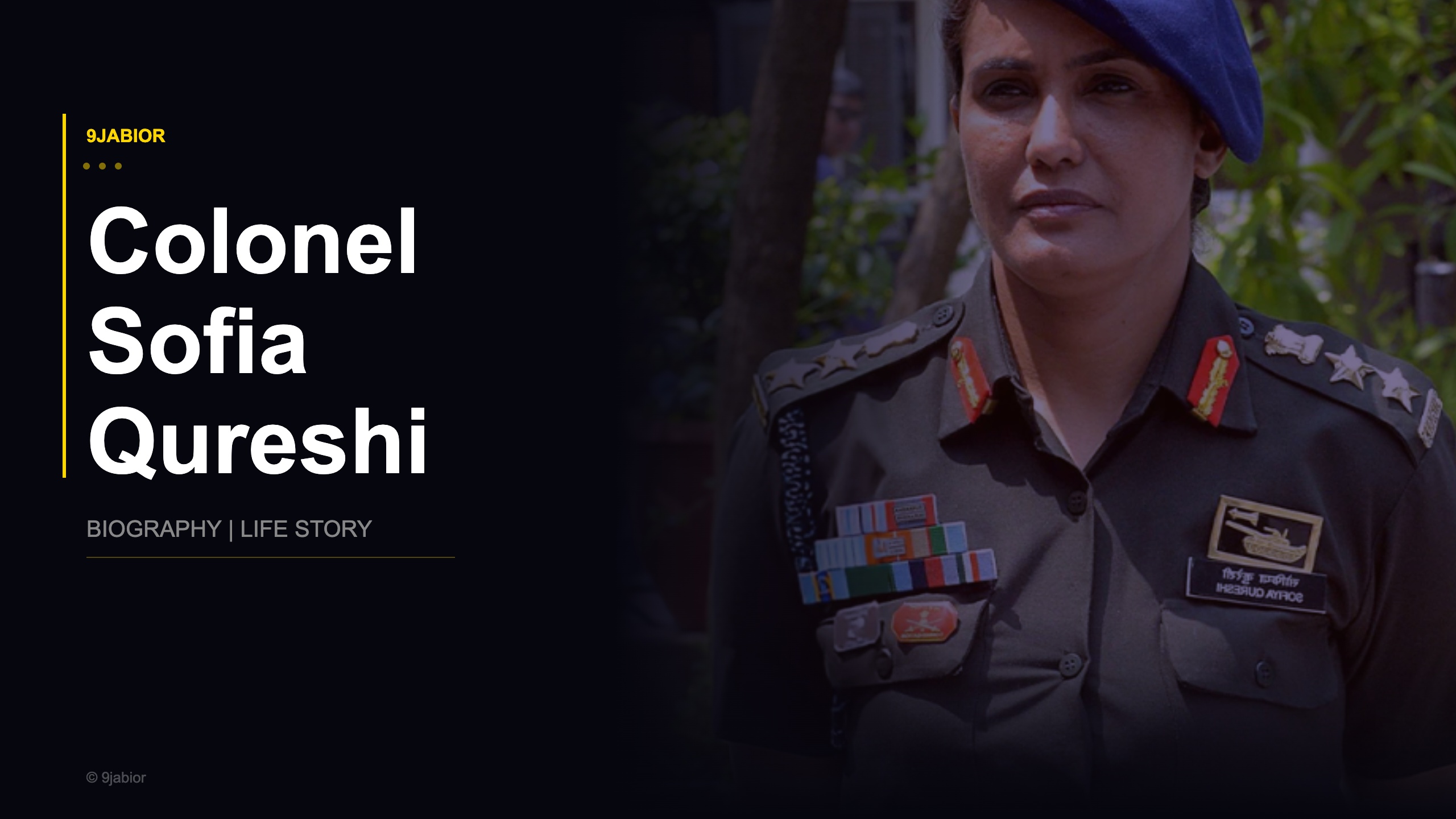
Colonel Sofia Qureshi Biography-On the evening of May 7, 2025, millions of Indians sat glued to their screens. India had just launched a precision military strike — Operation Sindoor — targeting terrorist camps in Pakistan and Pakistan-occupied Kashmir. And the officer standing at the podium, calm as still water, briefing the entire country on what had just happened, was a woman in an olive-green uniform.
That woman was Colonel Sofia Qureshi.
If you hadn’t heard her name before that night, you weren’t alone. But by the next morning, she was everywhere — in headlines, in WhatsApp forwards, in conversations between strangers on trains. People wanted to know: who is this woman, where did she come from, and how on earth did she end up at the centre of one of India’s most significant military operations?
This is her story. And it’s one you’ll want to read slowly.
Who Is Colonel Sofia Qureshi? A Quick Overview
The Woman Who Stood Before the Nation
Colonel Sofiya Qureshi, VSM, is a senior officer in the Indian Army’s Signal Corps. She’s a decorated soldier, a trailblazer, and — before May 2025 — a relatively low-profile name in the public eye. That changed the moment she stepped up beside Wing Commander Vyomika Singh to deliver India’s official military briefing on Operation Sindoor.
It wasn’t just what she said. It was who she was that made headlines. A Muslim woman in the Indian Army, born in Gujarat, with a family military legacy stretching back over a century, standing as the face of India’s strongest counter-terrorism response in years. The symbolism wasn’t lost on anyone.
Why Her Name Became a Household Word Overnight
The Indian Army doesn’t usually put women at the forefront of wartime press briefings. But Colonel Qureshi wasn’t chosen for optics. She was chosen because she’d earned it — through decades of service, multiple international deployments, and the kind of quiet, steady leadership that speaks louder than press releases.
Early Life and Family Roots: A Legacy That Runs Four Generations Deep
Born in Vadodara: Where It All Began
Sofia Qureshi was born in Vadodara, Gujarat — a city known for its art, its universities, and, as it turns out, at least one extraordinary soldier. Her parents are Mohammad Qureshi (also recorded in some sources as Taj Mohammad Qureshi) and Amina Qureshi. She grew up in the Tandalja locality of Vadodara, in a household where military service wasn’t just a career — it was the family’s way of life.
A Family That Has Served Since 1857
Here’s the part that’ll stop you mid-scroll.
Sofia’s great-grandmother was part of the Indian Rebellion of 1857, and also served in the British Indian Army. Her grandfather served in the Indian Army’s Religious Teacher (RT) cadre, providing moral and spiritual guidance to soldiers. Her father, Taj Mohammad Qureshi, fought in the 1971 Indo-Pakistan War as part of the Corps of Electronics and Mechanical Engineers.
That’s four generations of military service. When Sofia joined the Indian Army in 1999, she wasn’t stepping into a career. She was continuing a chapter of a very old story.
Her sister Saina Qureshi also dreamed of joining the Army, but couldn’t qualify due to height requirements. And her twin sister, Shyna Sunsara, chose a different path — she co-runs a film production house in Mumbai. Two sisters, two completely different worlds, and both have something to say about the night their family name lit up every television in India.
Growing Up Around the Tricolour
Growing up near military postings and around soldiers gave Sofia a perspective that most children don’t get. Discipline wasn’t something she had to learn. It was something she absorbed. The values of service, sacrifice, and national pride weren’t abstract concepts — they were the dinner table conversations of her childhood.
Education: From Science Labs to the Officers Training Academy
Schooling at Kendriya Vidyalaya
Sofia began her formal education at Kendriya Vidyalaya, EME (Electrical and Mechanical Engineers) in Vadodara — the same kind of school attended by many children of Army personnel across India. It’s a disciplined environment, academically rigorous, and it clearly suited her. She developed an early love for science.
The University Years — Biochemistry and a Change of Plans
She went on to the Maharaja Sayajirao University of Baroda, one of Gujarat’s premier academic institutions. There she earned her Bachelor of Science in Chemistry and later a Master of Science in Biochemistry. She was good at it — genuinely good. Good enough that she started seriously considering research as a career, possibly a PhD.
The PhD She Left Behind — and Why
This is a turning point in her story that most biographies skip past too quickly. Sofia was on the verge of pursuing a doctoral degree when she learned that the Indian Army was actively recruiting women officers. Something clicked. The pull of family legacy, the desire to serve the country in a more direct way, and perhaps just an honest conversation with herself — whatever it was, she made the call that changed her life.
She didn’t pursue the PhD. She applied for the Officers Training Academy instead. And she got in.
Officers Training Academy, Chennai
The Officers Training Academy (OTA) in Chennai is where the Indian Army transforms civilians into officers. It’s gruelling, demanding, and not for the faint-hearted. Sofia completed her training here and was commissioned into the Indian Army in 1999. She later pursued a Master’s in Defence and Strategic Studies from the Defence Services Staff College in Wellington (2005–06), and in 2018, attended the National Defence College in New Delhi for a course in strategic cybersecurity. The woman never stopped studying.
Joining the Indian Army: The Decision That Changed Everything
Why Sofia Chose Service Over Research
When asked in interviews about what drew her to the Army, Sofia’s answers are simple and direct. It’s the love for the nation, she says. The honour of wearing the uniform. The same charm that draws men to military service drew her as well. She doesn’t speak in grand, theatrical terms. She speaks like someone who made a clear-eyed decision and never looked back.
Signal Corps: The Brain Behind the Army’s Communication
Sofia joined the Army Signal Corps — a branch that most people outside the military know very little about, but which is absolutely critical to how the Indian Army functions. Think of it this way: if the Army is a body, the Signal Corps is the nervous system. It handles all military communication — radio networks, digital systems, encrypted channels, and the information infrastructure that keeps commanders connected to their troops, especially during active operations.
Sofia didn’t just serve in the Signal Corps. In 2001, she played a key role in developing the Indian Army’s first mobile digital communication network. That’s not a footnote. That’s a foundational contribution to how modern India’s military communicates.
Early Postings and Counter-Insurgency Operations in J&K
After commissioning, she was posted across various locations in India, including counter-insurgency zones in Jammu & Kashmir and North-East India. These are not desk jobs. These are postings in areas of active conflict, where communication failures can cost lives. Sofia handled it.
Career Milestones: A Timeline of Firsts
2001 — Building India’s First Mobile Digital Communication Network
This achievement often gets buried under the more dramatic headlines, but it shouldn’t. Developing a mobile digital communication network for an army of over a million soldiers isn’t a small task. Sofia was part of the team that made it happen, and it laid the groundwork for the digital communication capabilities the Indian Army relies on today.
2006 — United Nations Peacekeeping Mission in Congo
In 2006, Sofia was deployed to the Democratic Republic of Congo as part of the United Nations Peacekeeping Operations (UNPKO). She served as a military observer, monitoring ceasefire agreements and supporting humanitarian missions in one of the world’s most volatile conflict zones.
What She Did in the DRC That Earned Her Local Recognition
This deployment gave Sofia something that textbooks can’t teach — experience in real-world humanitarian crisis management. During her time in the DRC, her work included helping reunite a child with her mother. Small act, enormous meaning. She earned local recognition for her work there, and she later described the deployment as a proud moment in her career, urging fellow women officers to work hard and make the country proud.
2016 — Exercise Force 18: The History-Making Moment
What Exercise Force 18 Actually Was
Exercise Force 18 is the largest foreign military exercise ever hosted by India. Held in Pune in March 2016, it brought together military contingents from 18 nations — including Japan, China, Russia, the United States, Australia, South Korea, New Zealand, and members of ASEAN. The exercise focused on peacekeeping operations, humanitarian assistance, and mine-clearance techniques.
It wasn’t a photo-op. It was a serious multinational military training exercise, and someone had to lead India’s 40-member contingent.
Leading 40 Soldiers as the Only Woman Commander Among 18 Nations
That someone was Sofia Qureshi — then a Lieutenant Colonel. She was the only woman Contingent Commander among all 18 participating nations. Not just India’s first. All 18 countries’ first. When asked how she felt about it, she said simply: “I feel proud, of course.” Her message to young women? “Work hard for the country and make everyone proud. Join the Army.”
Then-Army Commander of Southern Command, the late General Bipin Rawat, made it clear at the time that her selection wasn’t symbolic. He stated that her appointment was based entirely on her capabilities and leadership qualities — not her gender.
2018 — Strategic Cybersecurity at National Defence College
In 2018, Sofia attended the National Defence College in New Delhi for a programme in strategic cybersecurity. This tells you a lot about how she thinks. She’s not someone who coasts on past achievements. Even after making history at Force 18, she was actively expanding her skills into one of the most rapidly evolving areas of modern warfare.
2020 — Training India’s First Batch of Women Military Police
Serving as Second-in-Command of the Military Provost Unit, Sofia trained the first-ever batch of Women Military Police, who were subsequently deployed in counter-insurgency zones. Think about that. She didn’t just break through barriers — she pulled others through behind her.
Operation Sindoor: The Moment India Watched Colonel Sofia Qureshi
What Was Operation Sindoor?
On April 22, 2025, a devastating terrorist attack in Pahalgam, Jammu & Kashmir, claimed the lives of 26 civilians. India’s response came swiftly. On May 7, 2025, the Indian military launched Operation Sindoor — a precision cross-border strike targeting terrorist infrastructure in Pakistan and Pakistan-occupied Kashmir. The operation hit nine sites, including camps in Bahawalpur, Muridke, and Balakot — locations linked to the Pahalgam attack.
It was India’s most significant military action in years, and the country needed someone to stand before the cameras and explain what had happened.
Why She Was Chosen to Brief the Nation
The Indian Army and Ministry of Defence made a deliberate choice: Colonel Sofia Qureshi of the Army and Wing Commander Vyomika Singh of the Air Force would jointly brief the media, alongside Foreign Secretary Vikram Misri. For the first time in Indian military history, two women officers fronted the nation’s official communications after a major military operation.
It wasn’t tokenism. It was trust.
What She Said at the Podium — and Why It Mattered
Sofia stood at the podium — calm, precise, authoritative. She laid out the details of the operation with the clarity of someone who had spent decades learning how to communicate under pressure. The nation didn’t just hear the facts about Operation Sindoor. It watched a Muslim woman officer from Gujarat speak for the Indian Army. That image said something loud and clear about what India’s military is becoming.
Her twin sister Shyna later told reporters that Sofia hadn’t said a word about the upcoming briefing the day before. Even to family. That’s discipline. That’s the mark of a professional.
Standing Alongside Wing Commander Vyomika Singh
Wing Commander Vyomika Singh is a decorated helicopter pilot and another pioneering woman officer in India’s armed forces. The two women standing together — one from the Army, one from the Air Force — at what was essentially India’s wartime press conference, became one of the defining images of 2025. It wasn’t planned as symbolism. It was a statement of where India’s military is heading.
Awards and Honours: Recognizing a Life of Service
The Vishisht Seva Medal (VSM)
The Vishisht Seva Medal is one of the Indian Army’s highest service recognitions. Colonel Sofia Qureshi, VSM — those three letters after her name aren’t decoration. They represent distinguished service over a career that has consistently gone above and beyond.
Gandhi Peace Award 2019
In 2019, she received the Global Peace Gandhi Award — a recognition of her contributions to international peacekeeping, particularly stemming from her work in the Congo. It’s a civilian honour for a military professional, which is rare and speaks to the breadth of her impact.
Operation Vijay, Parakram, and Service Medals
Sofia has also received the Special Service Medal, Operation Vijay Medal, Operation Parakram Medal, Sainya Seva Medal, Videsh Seva Medal, the 75th Independence Anniversary Medal, and both the 20 Years and 9 Years Long Service Medals, along with the United Nations Medal for her Congo deployment. She also serves as Guest Faculty at the National Defence College — an acknowledgment that her expertise is worth sharing with the next generation of military leaders.
Personal Life: The Family Behind the Uniform
Her Husband Colonel Tajuddin Bagewadi
Colonel Tajuddin Bagewadi is from Konnur Village, Gokak Taluk, in Belagavi district, Karnataka. He’s an officer in the Mechanized Infantry of the Indian Army and currently posted in Jhansi. Two soldiers, two postings, one family. It takes a particular kind of strength — from both people — to make that work.
Their Love Story — From Fellow Officers to Life Partners
Theirs is the kind of love story that doesn’t need embellishment. They met while serving in the Indian Army. They fell in love. They got married in 2015 — in what family members describe as a love-cum-arranged marriage, with the blessings of both families. It’s a quiet story, told in the margins of a very public career.
Her Son and What He Wants to Do Next
The couple has a son, who is around 18 years old. And if reports are accurate, he wants to join the Indian Armed Forces. The cycle continues.
Her Twin Sister’s Emotional Reaction to Operation Sindoor
When Shyna Sunsara — Sofia’s twin, the woman who chose film production over fatigues — found out about her sister’s role in the Operation Sindoor briefing, she was emotional. She told reporters that Sofia had spoken to her the day before and hadn’t mentioned a single word. Not a hint. Not a clue. That’s Sofia Qureshi for you — composed, contained, and completely in control.
What Colonel Sofia Qureshi Means for Women in India’s Military
Breaking Barriers Without Making Noise About It
What’s remarkable about Sofia Qureshi isn’t just what she’s done. It’s how she’s done it — without fanfare, without campaigns, without press releases about being a pioneer. She led a 40-member contingent. She helped develop military communication technology. She trained India’s first batch of Women Military Police. She briefed the nation on a wartime operation. And through all of it, she kept the focus on the work.
Her Message to Young Women Who Want to Serve
Her message is short. Almost blunt. “Join the Army.” That’s it. She doesn’t dress it up with caveats or conditions. She doesn’t say it’s easy. She says do it. Work hard. Make the country proud.
For young Indian women — especially Muslim women — watching her on that podium in May 2025, it wasn’t just a briefing. It was permission. A live, breathing example that the uniform belongs to anyone willing to earn it.
The Bigger Picture: Women in the Indian Army Today
Women currently make up approximately 4.5% of the Indian Army. It’s a small number, and progress has been slow. But figures like Colonel Sofia Qureshi — and the institutional decisions that put her at that podium — suggest the curve is bending. Women are now serving in counter-insurgency zones, leading multinational exercises, training combat support units, and fronting national security communications.
It’s not equality yet. But it’s movement. And Colonel Qureshi is part of what’s moving it.
Frequently Asked Questions About Colonel Sofia Qureshi
Who is Colonel Sofia Qureshi? Colonel Sofiya Qureshi, VSM, is a senior Indian Army officer serving in the Signal Corps. She became nationally known for briefing the media on Operation Sindoor in May 2025, alongside Wing Commander Vyomika Singh. She is also the first woman to lead an Indian Army contingent at a multinational military exercise.
What is Operation Sindoor and what role did Sofia Qureshi play in it? Operation Sindoor was a precision military strike launched by India on May 7, 2025, targeting terrorist camps in Pakistan and Pakistan-occupied Kashmir, in response to the Pahalgam terror attack. Colonel Qureshi was chosen by the Indian Army to co-lead the national press briefing, making her one of the public faces of India’s military response.
What is the Indian Army Signal Corps? The Signal Corps is the branch of the Indian Army responsible for military communications — including radio networks, digital communication systems, and encrypted channels that keep commanders connected to troops during operations. It’s often called the “backbone” of operational coordination.
What awards has Colonel Sofia Qureshi received? She holds the Vishisht Seva Medal (VSM), the Gandhi Peace Award (2019), and several operational medals including the Operation Vijay Medal, Operation Parakram Medal, Sainya Seva Medal, Videsh Seva Medal, Special Service Medal, and the United Nations Medal for her peacekeeping work in Congo.
Who is Sofia Qureshi’s husband? Her husband is Colonel Tajuddin Bagewadi, an officer in the Indian Army’s Mechanized Infantry, currently posted in Jhansi. They married in 2015 and have one son.
Was Sofia Qureshi the first woman to lead an Indian Army contingent internationally? Yes. In 2016, she became the first woman officer to lead an Indian Army contingent at a multinational military exercise — Exercise Force 18 — making her the only woman Contingent Commander among all 18 participating nations.
What does Sofia Qureshi’s family background look like? Her family has an extraordinary military legacy. Her great-grandmother participated in the 1857 Indian Rebellion. Her grandfather served in the Indian Army’s Religious Teacher cadre. Her father fought in the 1971 Indo-Pakistan War. And her husband is an active-duty Army colonel.
What is Sofia Qureshi’s educational background? She holds a Bachelor of Science in Chemistry and a Master of Science in Biochemistry from Maharaja Sayajirao University of Baroda. She also completed advanced military education including a Master’s in Defence and Strategic Studies from the Defence Services Staff College, Wellington, and a strategic cybersecurity course at the National Defence College, New Delhi.

 Ghost Blogger