 Ghost Blogger
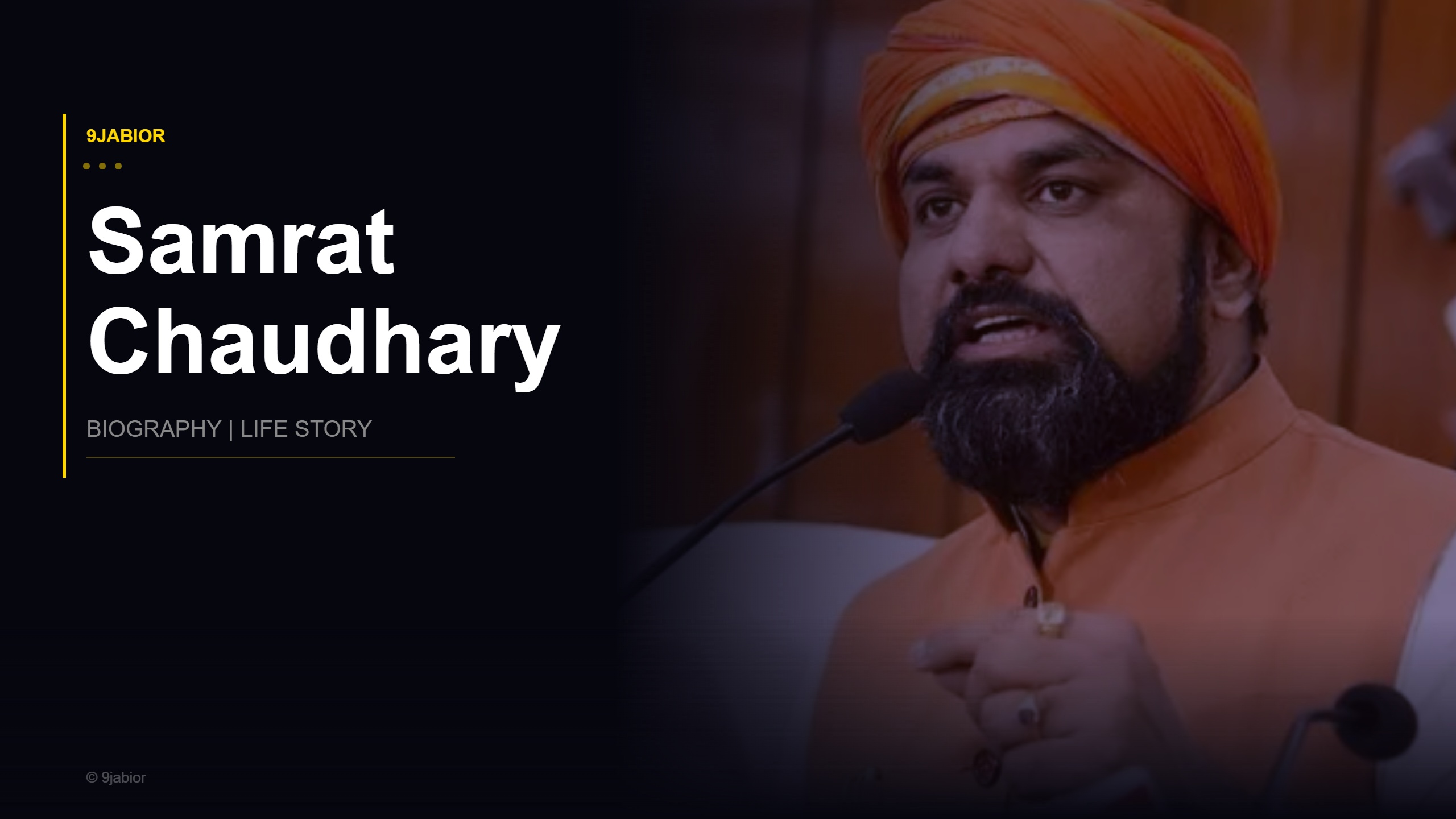
Bihar has seen a lot of political twists over the decades. But what happened in April 2026 was something the state had never witnessed before. For the first time in its history, a leader from the Bharatiya Janata Party was sworn in as the Chief Minister of Bihar. That man is Samrat Chaudhary — a fiery orator, a caste strategist, a former RJD loyalist, and now the face of a new chapter in Bihar’s political story.
The samrat chaudhary biography is not just about one man’s rise. It’s about how Bihar’s complex web of caste arithmetic, coalition politics, and party loyalty can catapult someone from a village in Munger all the way to the Chief Minister’s chair. Let’s break it all down.
Who Is Samrat Chaudhary?
Samrat Chaudhary — also spelled Samrat Choudhary — is an Indian politician from Bihar and a senior leader of the Bharatiya Janata Party. He currently serves as the Chief Minister of Bihar, having taken oath on April 15, 2026. Before this, he was the Deputy Chief Minister of Bihar from January 2024 to April 2026, serving in Nitish Kumar’s government.
He’s known for his aggressive communication style, his deep grassroots presence among OBC communities, and his sharp political instincts. Over a career spanning more than three decades, he’s served as MLA, MLC, state minister, BJP Bihar president, and Deputy CM — before finally reaching the top.
Quick Facts at a Glance
| Detail | Information |
|---|---|
| Full Name | Samrat Chaudhary (also Rakesh Kumar) |
| Date of Birth | November 16, 1968 |
| Place of Birth | Lakhanpur, Munger district, Bihar |
| Age | 57 years (as of 2026) |
| Caste | Koeri (Kushwaha) — OBC |
| Party | Bharatiya Janata Party (BJP) |
| Current Position | Chief Minister of Bihar (since April 2026) |
| Wife | Mamta Kumari |
| Children | One son, one daughter |
| Father | Shakuni Choudhary (seven-time MLA, MP) |
| Mother | Parvati Devi (former MLA) |
| Net Worth | ₹11.35 crore (declared) |
Born Into Politics: Early Life and Family Roots
Samrat Chaudhary didn’t stumble into politics. He was practically born into it.
He came into the world on November 16, 1968, in Lakhanpur village in Bihar’s Munger district. It’s a region that has long been dominated by OBC communities, particularly the Kushwaha or Koeri caste. But more than geography, it was his family that shaped everything.
The Legacy of Shakuni Choudhary
His father, Shakuni Choudhary, is one of Bihar’s most celebrated political veterans. The elder Choudhary served as an MLA no fewer than seven times and also held a seat in Parliament. He represented the Tarapur constituency across multiple decades and was a recognisable face across several parties — from the Congress era right through to the BJP-affiliated political formations.
Shakuni Choudhary was the kind of politician who knew how Bihar worked from the ground up. He understood caste equations, village dynamics, and how to keep voters loyal through thick and thin. Growing up watching that, Samrat absorbed it all.
Growing Up in a Political Household
Samrat’s mother, Parvati Devi, also served as an MLA from the Tarapur constituency. So you had both parents in active politics. Dinner table conversations in the Choudhary household must have been something else.
This background gave Samrat something many politicians spend decades trying to acquire — early credibility. People in Munger already knew his family name. That’s a head start most political newcomers never get. It’s also worth noting that his younger brother, Rohit Chaudhary, later entered politics through the Janata Dal United, which tells you how deeply politics runs in this family’s veins.
Samrat Chaudhary’s Educational Qualification
This is where things get genuinely interesting — and a little complicated.
Officially, Samrat Chaudhary holds a degree from Madurai Kamaraj University and has also been listed as holding an honorary doctorate (D.Litt). But his educational background has been a source of controversy throughout his political career.
The Doctorate Controversy Explained
In earlier election affidavits, his educational qualification was reportedly listed as having cleared only up to Class 7. That’s a significant gap from a university degree and a doctorate. Political strategist Prashant Kishor raised this contradiction publicly during the 2025 Bihar election campaign, questioning how someone who had stated Class 7 education in one document could suddenly claim a doctorate in another.
Chaudhary has publicly addressed these questions and defended his credentials. But the inconsistency has never been fully resolved to everyone’s satisfaction. In Bihar’s political culture, though, formal educational qualifications have rarely been the deciding factor in electoral outcomes. Voters often care more about community identity and accessible governance than university certificates. That’s a reality no number of degrees can change.
Political Journey: From RJD to Bihar’s Top Office
If you want to understand Samrat Chaudhary, you’ve got to trace his political journey from start to finish. It isn’t a straight line. It zigzags across parties, ideologies, and alliances in a way that only Bihar politics could produce.
Starting Out With the RJD
Chaudhary began his political career with the Rashtriya Janata Dal — Lalu Prasad Yadav’s party. In the late 1990s, he served as a minister in the cabinet of Rabri Devi, Lalu’s wife who was Bihar’s Chief Minister at the time. This was before the BJP had any real footprint in the state’s top-tier leadership.
It was a formative period. He saw how power worked, how patronage networks operated, and what it meant to govern a state as fractious and complex as Bihar. Even then, observers noted his sharp tongue and aggressive public style.
The Unexpected Removal of 1999
Here’s a detail that rarely gets enough attention. In 1999, Samrat Chaudhary was removed from his ministerial post — not due to corruption or scandal, but because he was found to be underage for the role at that time. It was an embarrassing moment in an otherwise rising career.
But here’s the thing about politicians with genuine political instincts: they don’t collapse under setbacks. They use them. That early stumble likely sharpened his focus considerably.
Crossing Party Lines — RJD to JD(U) to BJP
Political affiliations shifted dramatically in Bihar through the 2000s and 2010s. Chaudhary was elected as MLA from Parbatta in 2000 and again in 2010, showing he could win votes independently of any single party umbrella.
In 2014, he was part of a faction that split from the RJD, and he subsequently worked with the JD(U) government under Jitan Ram Manjhi. During that phase, he served as the Minister of Urban Development and Housing. By 2017–2018, he crossed over to the BJP — the party that would ultimately take him the furthest.
Building a New Identity Inside the BJP
When Chaudhary joined the BJP, the party was already recognising his potential. He was appointed State Vice President almost immediately. His profile as a fiery OBC leader from the Kushwaha community aligned perfectly with the BJP’s strategic interest in broadening its social base beyond its traditional upper-caste support in Bihar.
By 2019, he was working as deputy to BJP Bihar president Nityanand Rai. By 2022, he became the Leader of Opposition in the Bihar Legislative Council. By March 2023, he was appointed the president of the BJP Bihar unit — one of the most powerful organisational positions in the state.
The Saffron Turban: A Vow That Defined His Career
You cannot write about Samrat Chaudhary without dedicating serious space to the turban story. It’s the image that most people in Bihar associate with his name.
During the period when the BJP and JD(U) were in opposition — after Nitish Kumar aligned with the Mahagathbandhan — Chaudhary made a very public vow. He would wear a saffron turban and would not remove it until the BJP returned to power in Bihar. It was theatrical. It was bold. And it was quintessentially Bihari in its symbolic weight.
What the Turban Symbolised in Bihar Politics
In Bihar’s political culture, public vows carry real stakes. When a leader makes a pledge like that in front of party workers and media cameras, it creates a form of accountability that’s almost impossible to walk back from. Either BJP comes back to power or the turban stays on — and so does the political damage.
Chaudhary was betting everything on the electoral outcome. It was either a stroke of brilliance or a massive gamble. As it turned out, the NDA swept the 2025 Bihar elections, the BJP became the single largest party with 89 seats, and Chaudhary removed that turban as Bihar’s incoming Chief Minister. The symbolism hit hard in every constituency where BJP workers had watched that journey unfold. It made his elevation feel like the culmination of a promise kept — which is exactly what it was.
The Kushwaha Factor: Caste, Clout and Coalition
To understand why Samrat Chaudhary rose to the top of Bihar politics, you need to understand caste. Not in a shallow way, but in the deeply structural way that Bihar’s political landscape operates.
Chaudhary belongs to the Koeri community, more commonly known as the Kushwaha caste. It’s classified as an Other Backward Class (OBC) in Bihar and is considered the second largest caste group in the state after the Yadavs.
What Is the “Luv-Kush” Equation in Bihar?
In Bihar’s political language, the “Luv-Kush” equation refers to an alliance or representation combining the Kurmi community (associated with Lav, as in Luv) and the Kushwaha community (associated with Kush). Nitish Kumar, a Kurmi leader, had long benefited from this combined OBC bloc.
By positioning Chaudhary — a Kushwaha — as his deputy and eventual successor, the BJP was trying to keep this powerful caste coalition intact while transitioning power from JD(U) to itself. It’s political chess played at the community level.
Why the BJP Needed a Kushwaha Face
The BJP had traditionally been seen as an upper-caste party in Bihar. To expand beyond that ceiling, it needed credible OBC leadership. Chaudhary fit that role almost perfectly. He wasn’t parachuted in from Delhi. He’s a genuine grassroots leader who has built his network across multiple parties and constituencies over decades.
When Giriraj Singh publicly projected Chaudhary as BJP’s chief ministerial candidate for Bihar at a Begusarai rally in 2023, it wasn’t just a statement — it was a signal to every Kushwaha voter in the state.
Samrat Chaudhary as Deputy Chief Minister (2024–2026)
When Nitish Kumar returned to the NDA fold in January 2024, Chaudhary was sworn in as one of Bihar’s two Deputy Chief Ministers. It was a major step up and gave him direct executive authority for the first time at that level.
Key Portfolios He Held
As Deputy CM, Chaudhary handled an impressive range of portfolios including Finance, Urban Development and Housing, Health, Panchayati Raj, Industry, Commercial Taxes, and Sports. That’s not a light load. Managing Finance alone would be a full-time job in most states.
In 2024, he was also made the convener of the Group of Ministers on the Goods and Service Tax rate rationalisation panel — a significant national-level responsibility that put him in rooms with Union ministers and finance officials from across the country.
Law and Order Initiatives Under His Watch
As Home Minister, Chaudhary took a notably firm approach. He launched an Anti-Romeo squad to address eve-teasing cases, cracked down on drug and liquor mafias, and announced action against land-grabbing criminals. He also formed the ‘Abhay Brigade’ — a special unit focused on women’s safety at public places.
In December 2025, he directed the establishment of 100 fast-track courts across Bihar to speed up case disposal and reduce the court backlog. He also pushed to reduce the response time for the ‘Dial 112’ emergency service to under ten minutes. It all felt very much like the playbook of Yogi Adityanath in Uttar Pradesh — tough messaging, visible enforcement, and a clear political narrative around law and order.
Bihar’s First BJP Chief Minister: April 2026
On April 15, 2026, Samrat Chaudhary was sworn in as the Chief Minister of Bihar — the first BJP member ever to hold that office in the state’s history.
It happened after Nitish Kumar’s decision to move to the Rajya Sabha, which required the government to be reconstituted. The BJP, as the largest party in the NDA coalition, was entitled to nominate the new Chief Minister. Chaudhary was elected as the BJP legislative party leader and took oath the following morning.
How the 2025 Bihar Election Changed Everything
The 2025 Bihar Legislative Assembly election was the foundation for everything that followed. The BJP contested aggressively, with Chaudhary leading the campaign from the front. He himself ran from Tarapur constituency — his family’s traditional political home — and won decisively with 1,22,480 votes, defeating RJD’s Arun Kumar by 45,843 votes.
The BJP emerged as the single largest party in the Bihar assembly with 89 seats. It was a clear mandate. And it created the conditions for the party to claim the Chief Minister’s chair for the very first time.
What His Elevation Means for Bihar Politics
Chaudhary’s elevation marks a structural shift in Bihar’s political order. For roughly three decades, the top job in Bihar alternated between Lalu Prasad Yadav’s RJD and Nitish Kumar’s JD(U). The BJP was always the supporting act.
That changes now. The BJP runs the show with its own man in Patna. What that means for coalition politics, for caste dynamics, and for development policy in Bihar will be something political analysts will be unpacking for years.
Samrat Chaudhary’s Net Worth and Assets
Chaudhary’s financial background is a matter of public record, as Indian candidates are required to file affidavits declaring their assets before elections.
Declared Assets Breakdown
According to his latest disclosed election affidavit, Samrat Chaudhary’s total net worth stands at approximately ₹11.35 crore — a dramatic increase from around ₹69 lakh that was declared roughly a decade ago.
Self-Declared Assets:
- Bank balance and cash: ₹28.45 lakh
- Vehicle: ₹7 lakh
- Weapons (licensed): ₹6 lakh
- Land and house property: ₹3.86 crore
Wife Mamta Kumari’s Declared Assets:
- Bank balance and cash: ₹12.10 lakh
- Land and house property: ₹5.50 crore
The bulk of the family’s wealth is concentrated in real estate. This includes agricultural and non-agricultural land across Tarapur, Munger, and Vaishali, along with a commercial space in Patna. His movable assets include mutual funds, insurance policies, and savings schemes. As per the affidavit, there are no declared loans or outstanding liabilities.
Family Life: Wife, Children, and Personal Side
Samrat Chaudhary is married to Mamta Kumari. The couple has two children — one son and one daughter. Unlike many political families in Bihar, Mamta Kumari has maintained a relatively low public profile, though her financial assets are part of the family’s declared affidavit.
Mamta Kumari and the Family’s Political World
While Mamta isn’t known to hold elected office or a prominent public role, she is clearly part of a household where politics is the constant backdrop. With both in-laws, a father-in-law, and now a husband at the very top of Bihar’s government, the Choudhary household has a multi-generational stake in the state’s political direction.
Chaudhary also has a brother, Rohit Chaudhary, who entered politics through the Janata Dal United, which added an interesting inter-party dimension to the family’s political reach.
Controversies Surrounding Samrat Chaudhary
No biography of Samrat Chaudhary would be complete without addressing the controversies that have followed him through his career. He’s not a politician who’s operated in the shadows — and that kind of visibility invites scrutiny.
The Prashant Kishor Allegations
During the lead-up to the 2025 Bihar elections, political strategist Prashant Kishor — a prominent critic of Bihar’s incumbent leadership — made serious public allegations against Chaudhary. These included questions about the authenticity of his educational qualifications and, more seriously, alleged involvement in criminal cases including murder charges.
Chaudhary responded publicly and denied the most serious allegations. The matter did not significantly derail his electoral campaign or his political standing within the BJP. He won his seat comfortably and eventually became Chief Minister.
That said, the controversy did put a spotlight on the broader issue of affidavit inconsistencies among Indian politicians, where self-declared details across different election cycles don’t always match up.
Criminal Cases: What the Records Say
According to information filed in election affidavits and available on the Association for Democratic Reforms (ADR) database, one formally recorded charge against Chaudhary relates to assault or criminal force to deter a public servant from discharging duty — this falls under Section 353 of the IPC. This case appears to relate to events during political protests.
It’s worth noting that criminal cases are not unusual in Indian politics. The Supreme Court has repeatedly drawn attention to the prevalence of politicians with pending cases. What matters legally is a court conviction — and Chaudhary has not been convicted in any of the cases alleged against him.
The earlier controversy about being removed from a ministerial post in 1999 for being underage is also part of the biographical record, though that situation reflected an administrative anomaly rather than any criminal wrongdoing.
Frequently Asked Questions About Samrat Chaudhary
Who is Samrat Chaudhary and why is he famous? Samrat Chaudhary is a Bihar politician and the Chief Minister of Bihar since April 2026. He’s the first BJP leader to hold that position in the state’s history. He’s known for his aggressive political style, his OBC leadership credentials, and his famous turban vow.
What is Samrat Chaudhary’s caste? He belongs to the Koeri (Kushwaha) community, classified as Other Backward Class (OBC) in Bihar. He’s widely regarded as one of the most prominent Kushwaha political faces in the state.
Who is Samrat Chaudhary’s father? His father is Shakuni Choudhary, a veteran politician who served as MLA seven times and also held a seat in Parliament. Both his parents — including his mother Parvati Devi — served as legislators, making it a deeply political family.
What is Samrat Chaudhary’s net worth? His declared net worth is approximately ₹11.35 crore, based on the latest election affidavit. The majority of his family’s wealth is held in land and real estate across Bihar.
Is Samrat Chaudhary the first BJP Chief Minister of Bihar? Yes. When he took oath on April 15, 2026, he became Bihar’s first-ever Chief Minister from the Bharatiya Janata Party, ending decades of JD(U) and RJD dominance at the top.
What is Samrat Chaudhary’s educational qualification? He holds a degree from Madurai Kamaraj University and is also cited with an honorary doctorate (D.Litt). However, earlier affidavits reportedly listed his education as Class 7 pass, creating a public controversy that political strategist Prashant Kishor highlighted during the 2025 election campaign.
Why did Samrat Chaudhary wear a saffron turban? He took a public vow to wear a saffron turban until the BJP returned to power in Bihar. The BJP swept the 2025 Bihar elections, and Chaudhary removed the turban when he was sworn in as Chief Minister — fulfilling the symbolic pledge he had made in front of party workers and the media.
What portfolios did Samrat Chaudhary hold as Deputy CM? As Deputy Chief Minister from January 2024, he oversaw Finance, Health, Urban Development and Housing, Panchayati Raj, Industry, Commercial Taxes, and Sports. He was also made convener of the GST rate rationalisation Group of Ministers panel at the national level.

 Ghost Blogger