 Ghost Blogger
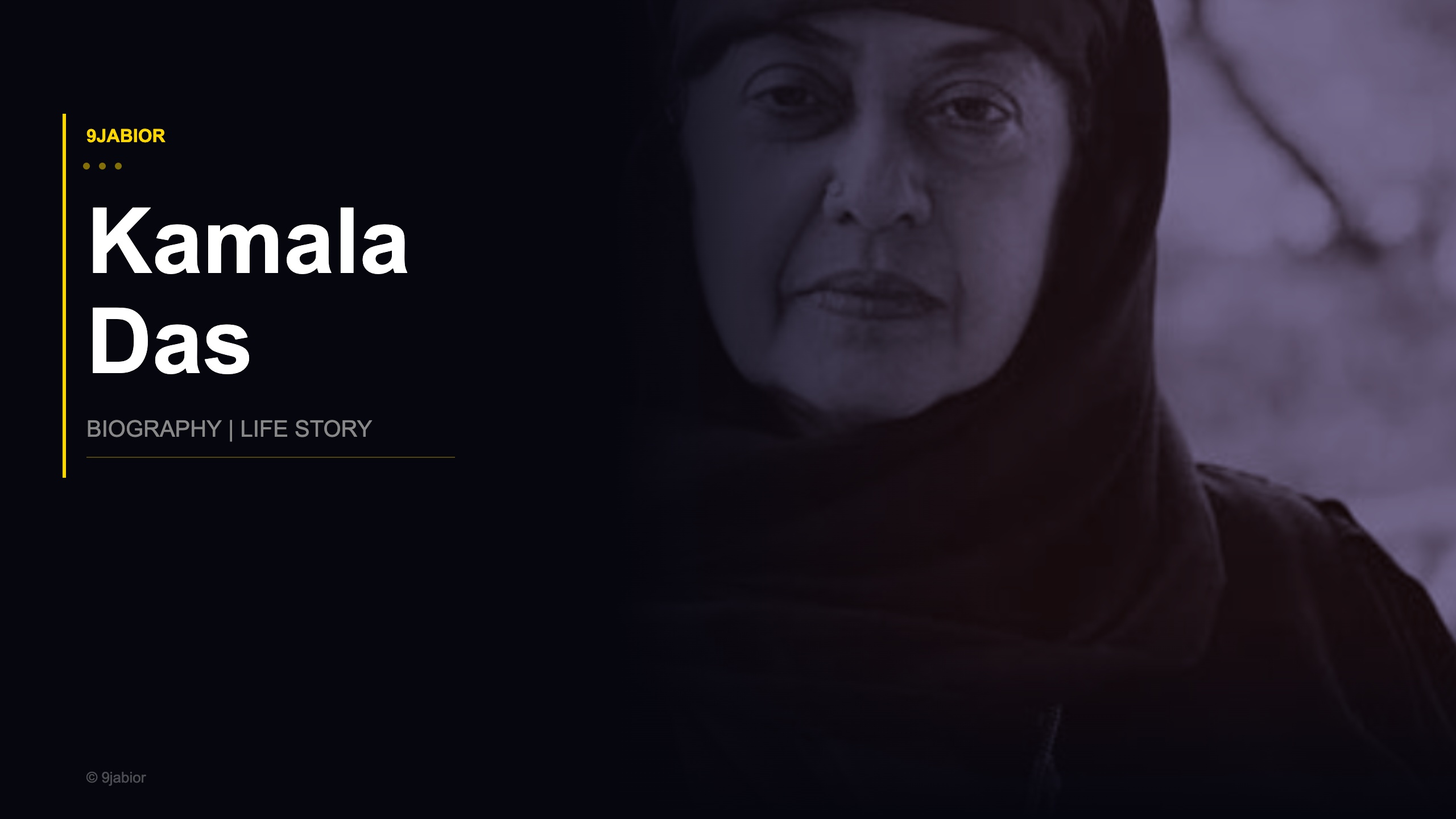
Kamala Das Biography-There’s a particular kind of courage in telling the truth when everyone around you has agreed to stay silent. Kamala Das had that courage — and it cost her comfort, reputation, and peace. But it gave Indian literature something it had never seen before: a woman’s voice, unfiltered, unapologetic, and unmistakably alive.
Whether you know her as Kamala Das, Madhavikutty, or Kamala Surayya, this is the story of one of the most remarkable — and misunderstood — literary figures in modern India. A poet who wrote about female desire in a society that didn’t want women to have any. A wife who was married at fifteen and found her identity in words. A woman who converted religions at sixty-five and still didn’t care what you thought about it.
This is the complete Kamala Das biography — her life, her works, her controversies, and her lasting impact on Indian literature.
Who Was Kamala Das? A Quick Overview
Kamala Das (March 31, 1934 – May 31, 2009) was an Indian poet and author widely regarded as one of the most important voices in postcolonial Indian writing. She wrote in two languages — English and Malayalam — and in each, she created a separate but equally powerful literary identity.
She’s often called the “Mother of Modern Indian English Poetry,” a title that The Times bestowed on her in 2009, the year she died. Her work was radical not just for what it said, but for how it said it — with a directness, a personal honesty, and a refusal to pretend that broke the mold of Indian women’s writing entirely.
The Three Names of One Woman
You’ll see three different names attached to this one woman, and it’s worth understanding why.
Kamala Das was the name she used when writing in English — particularly for her poetry, which brought her national and international recognition.
Madhavikutty was her pen name in Malayalam. Under this name, she wrote short stories, novels, and columns that made her a literary icon in Kerala.
Kamala Surayya was the name she took after converting to Islam in 1999. In her final decade, this was how she was officially known.
Same woman. Three names. Endless complexity.
Early Life and Family Background
Born Into Literary Royalty
Kamala Das was born on March 31, 1934, in Punnayurkulam, in the Thrissur district of what is now Kerala, India. She came from the Nair community — a matrilineal Hindu caste with a long tradition of education and cultural life.
But it wasn’t just any family she was born into. Her mother, Nalapat Balamani Amma, was one of the most celebrated Malayalam poets of the twentieth century. Her great-uncle, Nalapat Narayana Menon, was a renowned writer and translator — a man who had translated Victor Hugo’s Les Misérables into Malayalam and written what is considered the first modern sexology manual in the language.
Literature wasn’t something Kamala Das stumbled into. It was the air she breathed from birth.
Two Childhoods, Two Worlds
Her early years were split between two very different environments. Part of her childhood was spent in Punnayurkulam — in the ancestral tharavadu (family home) with its old Kerala rhythms, matrilineal customs, and the smell of rain on red earth. The other part was spent in Calcutta, where her father, V.M. Nair, worked as a senior executive at a company dealing in luxury automobiles.
These two worlds — the Kerala of tradition and memory, and the Calcutta of ambition and modernity — became a recurring tension in her writing. She never fully belonged to either. And it’s that sense of not-quite-belonging that gave her writing its restless, searching quality.
The Influence of Her Mother Balamani Amma
People often talk about Kamala Das as if she appeared from nowhere, a radical anomaly in Indian women’s literature. But her mother Balamani Amma is essential context. Balamani Amma wrote poetry that celebrated motherhood and domesticity — a deeply different thematic space from her daughter’s work, but no less serious as a literary project.
What Kamala inherited from her mother wasn’t a style. It was a seriousness about writing. The sense that literature was real work, worthy of a woman’s full attention and best effort. In a society that still treated women’s writing as a hobby, that was a radical inheritance in itself.
The Great-Uncle Who Sparked a Fire
She remembered watching Nalapat Narayana Menon work from morning until night at his desk, and thinking he had a blissful life. That image — of a person fully absorbed in the act of creation — stayed with her. She wanted that. She spent most of her adult life trying to carve out even a fraction of that freedom for herself.
By the time she was six, she had already started a small manuscript magazine where she’d write sad poems about headless dolls and her brother would illustrate them. The literary instinct was there from the very beginning.
Marriage at Fifteen — A Life-Altering Turn
The Age Gap and What It Really Meant
When Kamala was fifteen years old, she was married off to K. Madhava Das, a bank officer who was considerably older than her. She was a teenager. He was a grown man with a career. And yet, accounts of their marriage are complicated — Das herself described the dynamic with both bitterness and, occasionally, gratitude.
She spoke openly in her writing about the physical reality of being a teenage girl married to an older man — the sense of being used, of performing a role she hadn’t chosen. In her famous poem “An Introduction,” she describes the pressure to conform, to “be wife, be embroiderer, be cook… fit in, belong.”
But Madhava Das was also, by many accounts, genuinely supportive of her writing. He encouraged her to associate with people her own age, recognized her talent, and provided stability that allowed her to write. The truth is probably somewhere between the two extremes — a complicated relationship between two people with a significant power imbalance, navigating the terrain as best they could.
They had three sons: Madhav Das Nalapat, Chinen Das, and Jayasurya Das. Madhava Das predeceased her in 1992 after forty-three years of marriage.
Writing at the Kitchen Table While the World Slept
Here’s an image that captures so much about Kamala Das’s life: after her family had gone to sleep, she would clear the kitchen table — the same one she’d used to cut vegetables — and sit down to type. Not a study. Not a quiet room of her own. A kitchen table, in the middle of the night, after everyone else was done needing her.
She did this for years. The schedule took a toll on her health — but she later said her periods of illness gave her more time at home, and therefore more time to write. She found the silver lining in suffering. That’s a very Kamala Das thing to do.
The Literary Career That Shook Indian Literature
What Is Confessional Poetry? (And Why Das Pioneered It in India)
Before diving into her work, it helps to understand the style she became synonymous with: confessional poetry.
Confessional poetry is exactly what it sounds like — poetry that speaks directly from personal experience, often about subjects considered private or taboo. In the Western tradition, poets like Sylvia Plath, Anne Sexton, and Robert Lowell made it famous. It’s raw. It’s personal. It names what other poetry politely avoids.
Kamala Das brought this mode to Indian English poetry — and she was doing it at a time when Indian women in particular were expected to project modesty, restraint, and domestic contentment. She didn’t. She wrote about sexual longing, marital unhappiness, physical desire, and the desperate search for love with a directness that left readers stunned.
She wasn’t the first Indian poet to write in English. But she was arguably the first to write like a human being who was also a woman — without filtering her inner life through convention or decorousness.
Summer in Calcutta — The Debut That Changed Everything
Her first published poetry collection, Summer in Calcutta (1965), arrived like a sudden storm. The poems in it explored romantic love, longing, and female desire with an openness that Indian English poetry had simply never seen. Critics didn’t quite know what to do with it — was it literature, or was it scandal?
It was literature. Serious, technically accomplished, emotionally true literature. And it established her as a voice that couldn’t be ignored.
Her Poetry in English — Six Collections, One Bold Voice
Over her lifetime, Kamala Das published six poetry collections in English:
- Summer in Calcutta (1965)
- The Descendants (1967)
- The Old Playhouse and Other Poems (1973)
- Collected Poems Vol. I (1984)
- Only the Soul Knows How to Sing (1996)
- Encountering Kamala (2007)
Each collection deepened and expanded her exploration of love, identity, spirituality, and womanhood. Her second collection, The Descendants, was even more explicit in its themes, including poems that spoke directly to the female body and female desire with a candor that was genuinely unprecedented.
Her poem “An Introduction” — from Summer in Calcutta — is probably her most-studied and most-quoted work. It opens with a declaration of identity and moves through language, gender, love, and selfhood with remarkable compression. It’s a poem that says: I exist, and here’s what that means, and I refuse to apologize for any of it.
Writing in Malayalam as Madhavikutty — A Separate Identity
It would be a mistake to think of Kamala Das purely as an English-language poet. As Madhavikutty, she was a major Malayalam author in her own right, celebrated for her short stories and columns.
Her Malayalam short stories — like Thanuppu (Cold, 1967) — were known for their warmth, psychological insight, and intimacy. She also wrote the memoir Balyakalasmaranakal (Memories of Childhood, 1987) in Malayalam.
In Kerala, it was Madhavikutty, not Kamala Das, who was the household name. The two identities were not contradictions — they were complements, two facets of the same complex, searching mind.
The name “Madhavikutty” itself is a reference to Madhavi, a figure from classical Indian storytelling — a courtesan, but also a symbol of independence and desire. That Das chose this name for her Malayalam identity says something about the kind of story she wanted to tell.
My Story — The Autobiography That Became a Legend
What “Ente Katha” (My Story) Is Really About
In 1973, Kamala Das began publishing her autobiography as a series of columns in the Malayalam weekly Malayalanadu. It was collected and published in Malayalam as Ente Katha — which simply means “My Story” — and then translated into English in 1976 under the same title.
What does it contain? Her childhood, her marriage, her relationships (including her admission of attraction to women), her search for love, her frustrations with domesticity, her ambitions as a writer. It’s written with a kind of fearless openness that was simply unheard of for an Indian woman at the time.
The autobiography didn’t just describe her life — it interrogated the conditions that shaped it. She wasn’t simply telling stories. She was making an argument about what it meant to be a woman in mid-century India.
Why It Shocked Kerala and Why Das Said They Were Pretending
The book caused an uproar. In Kerala and across India, people were shocked by its candor about sexuality, relationships, and personal freedom. But Das had a characteristically dry response. She said the Malayali audience wasn’t actually shocked — they were pretending to be shocked, to prove their innocence. She believed she was simply being vocal about things that had been happening quietly for years.
That’s a provocative take. But it also rings true about the selective outrage that tends to greet women who speak openly about private realities.
The Fiction Within the Facts
Years later, Das admitted that parts of My Story were fictional — or at least, not strictly accurate. This complicated the book’s reception but didn’t diminish its importance. Whether every scene happened exactly as described or not, the emotional truth of the autobiography — the loneliness, the desire, the search for love, the frustration with expectation — resonated with readers in a way that transcended factual accuracy.
That’s what great autobiographical writing does. It tells a truth that facts alone can’t capture.
Major Themes in Kamala Das’s Writing
Love, Desire, and Female Longing
Love is everywhere in Kamala Das’s work — but it’s never the comfortable, decorative love of greeting cards. It’s love as hunger, love as wound, love as an impossible search for something that society doesn’t allow women to have. In “An Introduction,” she writes of being every woman who seeks love. That universality was radical: she was claiming that her desire was also everyone’s desire, that the private and the collective were not separable.
Identity and the Ownership of Language
One of the most striking aspects of her career was the controversy over her writing in English. Critics told her it wasn’t her language, that she should write in Malayalam instead. Her response was both defiant and profound: she claimed English as hers, distortions and all. Her poem “An Introduction” addresses this directly — the English she uses is her English, shaped by her experience, her body, her history. Nobody else owns it.
This was not just a personal statement. It was a commentary on postcolonial literature and the question of who gets to speak in which language and why.
Spirituality, Krishna, and the Search for the Divine
What often gets lost in discussions of Das as a feminist icon is her deep spirituality. Her relationship with Krishna ran through her poetry like a river — not the devotional, compliant bhakti of traditional women’s prayer, but something more anguished and personal. In “Only the Soul Knows How to Sing,” she addresses Krishna directly, describing his love as both illuminating and imprisoning. She sought the divine as she sought human love — desperately, and with full knowledge of her own vulnerability.
The Body as a Battlefield
Her body was central to her work — not as an object but as a subject, a site of experience, desire, shame, pleasure, and resistance. She wrote about menstruation, pregnancy, aging, and sexual experience with a matter-of-factness that was unprecedented in Indian English literature. For Kamala Das, the body wasn’t something to be transcended or hidden. It was where life happened. It deserved to be written about.
Beyond Writing — The Many Lives of Kamala Das
The Nude Paintings That Sparked Outrage
Later in her life, Das turned to painting — and as with everything she did, she didn’t take the safe route. Her nude paintings caused considerable outrage in Kerala. People accused her of attention-seeking, of deliberate provocation. She had a response that was vintage Das: she saw her so-called faults not as faults but as characteristics, as strengths. “Why not,” she asked, “if you realize that you are only a human being?”
Her Run for Parliament in 1984
In 1984, Kamala Das contested the Indian Parliament elections as an independent candidate. She didn’t win. But the fact that she ran at all — a poet, a woman, famously controversial — was itself a statement. She later said she wanted to work for social causes, particularly for orphaned mothers, which was also the stated aim of the political party she later founded, the Lok Seva Party.
Politics didn’t suit her the way literature did. But it showed, once again, that she refused to be contained by anyone’s expectations of what a woman like her should be doing.
Syndicated Columnist — Finding a New Audience
When she moved away from poetry — partly because, as she bluntly said, “poetry does not sell in this country” — she became a widely-read syndicated columnist. Her columns ranged across women’s issues, childcare, politics, and social commentary, reaching an audience far wider than her poetry had. The directness that made her poetry so striking made her columns equally compelling.
The Nobel Prize Nomination Nobody Talks About
In 1984, Kamala Das was nominated for the Nobel Prize in Literature. This remarkable fact tends to get buried in discussions of her life, perhaps because she didn’t win and because she spent considerable energy later disputing a news story (allegedly planted by herself, according to the novelist Khushwant Singh — a claim she rejected) about the nomination.
Whether or not the nomination was self-promoted, the fact remains: she was considered for the highest literary honor in the world. That’s not nothing. For an Indian woman writing in English in the 1980s, it was extraordinary.
Conversion to Islam and Becoming Kamala Surayya
The Story Behind the Conversion
On December 11, 1999, at the age of sixty-five, Kamala Das converted to Islam and took the name Kamala Surayya. It was, by her own account, a profoundly personal spiritual decision — connected to a relationship with a younger Muslim man named Sadiq Ali, and to a long-held sense of searching for something her existing faith hadn’t given her.
She later wrote about the experience with characteristic openness — the sunlit river, the laughter, the recited Urdu couplets. Whether the full account should be taken literally or read as the kind of emotionally true storytelling she’d always practiced is, perhaps, beside the point.
The Controversy and the Criticism
The conversion created what might politely be called a furor. Some Hindus felt betrayed. Some critics said she’d done it for attention. Her response was the same as it had always been: she was simply doing what felt right to her, and the opinions of others were secondary to her own experience.
Her Later Life and Final Works
In her final years, she continued writing, reflecting, and engaging with the world around her — though with a quieter energy than in her blazing early career. Her posthumously published collection Closure: Some Poems and a Conversation (2009) contains some of her most meditative and, critics have noted, some of her finest late work. Her last book of translated short stories, The Kept Woman and Other Stories, was also published posthumously.
She remained, until the end, a woman who was impossible to categorize or contain.
Awards and Recognition
Kamala Das received significant recognition during her lifetime, though many felt she deserved far more. Her major awards include:
- PEN Asian Poetry Prize – 1964
- Kerala Sahitya Akademi Award – 1969 (for Thanuppu / Cold)
- Chairman Lal Award for Journalism – 1971
- Kendra Sahitya Akademi Award – 1984
- Asian World Prize for Literature – 1985
- Asian Poetry Prize – 1998
- Kent Award for English Writing from Asian Countries – 1999
- Vayalar Award – 2001
- Ezhuthachan Puraskaram – 2009
- Honorary D.Litt, University of Calicut – 2006
- Nobel Prize in Literature Nomination – 1984
She also held significant public positions: Vice-Chairperson of the Kerala Sahitya Akademi, Chairperson of the Kerala Forestry Board, and President of the Kerala Children’s Film Society, among others.
Death and Legacy
Her Final Days in Pune
Kamala Das died on May 31, 2009, at Jehangir Hospital in Pune, Maharashtra. She was seventy-five years old. Her body was flown back to Kerala, where she was buried with full state honors at the Palayam Jama Masjid in Thiruvananthapuram — as befitting a woman who had spent her life crossing every kind of boundary, including religious ones.
Why Kamala Das Still Matters Today
It’s tempting to read Kamala Das as a historical figure — important, yes, but belonging to another era. Don’t make that mistake.
Her questions are still our questions: Who gets to speak, and in what language? Whose desire is permissible, and whose must be hidden? What does it cost a woman to tell the truth about her own life? What does it mean to belong to a tradition while also fighting against it?
She didn’t resolve these tensions. She embodied them. And that’s precisely why her work remains so alive — because unresolved tensions are the truest reflection of the lives we actually live.
She broke open Indian women’s writing in a way that made space for every writer who came after her. She proved that honesty is not vulgarity. That the personal is not small. That a woman’s inner life is worthy of literature’s fullest attention.
That’s a legacy that doesn’t expire.
Frequently Asked Questions About Kamala Das
What is Kamala Das famous for? Kamala Das is famous for her bold, confessional poetry in English and her frank autobiographical writing. She was one of the first Indian women writers to openly address female sexuality, desire, identity, and the experience of womanhood in a patriarchal society. Her autobiography My Story (1976) and poems like “An Introduction” remain landmark works in Indian literature.
Why did Kamala Das convert to Islam? Kamala Das converted to Islam in December 1999, at age sixty-five, taking the name Kamala Surayya. She described the decision as deeply personal and connected to a spiritual search as well as a relationship with a younger Muslim man. The conversion was controversial but consistent with her lifelong pattern of making choices on her own terms, regardless of public opinion.
What is the pen name of Kamala Das? Kamala Das used two pen names. She wrote in Malayalam under the name Madhavikutty, and published her English poetry under her married name Kamala Das. After her 1999 conversion to Islam, she was officially known as Kamala Surayya.
What are the major themes in Kamala Das’s poetry? Her major themes include romantic love and its disappointments, female desire and sexual identity, the search for selfhood within marriage and social convention, spirituality and a personal relationship with the divine (particularly Krishna), the politics of language, and the tension between tradition and individual freedom.
Was Kamala Das nominated for the Nobel Prize? Yes, Kamala Das was nominated for the Nobel Prize in Literature in 1984. She did not win, and the nomination became part of a controversy when novelist Khushwant Singh alleged she had planted news stories about it herself — a claim she denied firmly.
What is My Story by Kamala Das about? My Story (originally Ente Katha in Malayalam, 1973; translated into English in 1976) is an autobiography in which Das writes candidly about her childhood, marriage at fifteen to an older man, her literary ambitions, her relationships, her sexuality, and her search for love and identity. It was groundbreaking for its honesty and remains a seminal text in Indian autobiographical writing. Das later acknowledged that parts of the book contained fictional elements.
What happened to Kamala Das at the end of her life? In her final years, Das lived in Pune, Maharashtra. She continued writing and reflecting on her life. She passed away on May 31, 2009, at age seventy-five, at Jehangir Hospital in Pune. She was buried with state honors in Thiruvananthapuram, Kerala.
How did Kamala Das influence Indian literature? Kamala Das fundamentally changed what was considered possible in Indian English poetry and women’s writing. She introduced the confessional mode to Indian English literature, broke taboos around female desire and sexuality, and created space for future generations of women writers to speak more freely about their inner lives. The Times called her “the mother of modern English Indian poetry” in 2009, the year of her death.

 Ghost Blogger