 Ghost Blogger
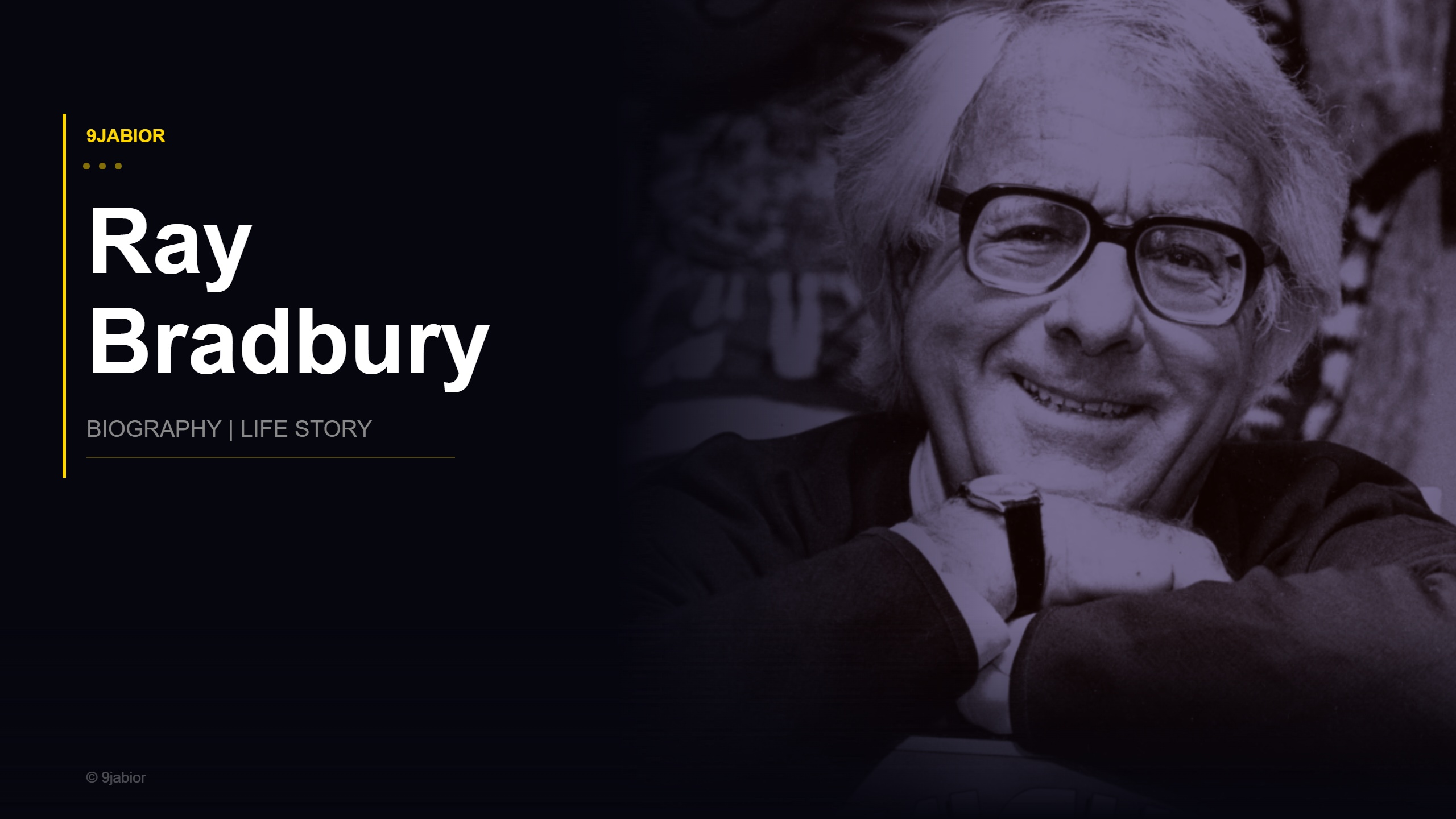
There’s a story Ray Bradbury Biography told over and over again throughout his life. It happened at a carnival in 1932. A magician touched him on the nose with an electrically charged sword and said, “Live forever.” And from that day forward, Bradbury did exactly that — through every word he wrote.
Ray Bradbury isn’t just one of the greatest writers America ever produced. He’s a testament to what happens when someone falls so completely in love with storytelling that they refuse to stop, no matter what life throws at them. No college degree. No car. No formal training. Just a typewriter, a library card, and an imagination that never stopped burning.
This is his full story.
Who Was Ray Bradbury? A Quick Overview
Birth, Full Name, and Family Background
Ray Douglas Bradbury was born on August 22, 1920, in Waukegan, Illinois. He was the third son of Leonard Spaulding Bradbury, a telephone lineman, and Esther Marie Moberg Bradbury, a Swedish immigrant. His grandfather and great-grandfather were newspaper publishers — so words were literally in his blood before he ever picked up a pen.
He lived until June 5, 2012, passing away in Los Angeles at the age of 91. In between those two dates, he wrote over 600 short stories, more than 30 books, dozens of screenplays, poems, essays, and plays. His work was translated into over 40 languages and sold millions of copies worldwide.
Why Ray Bradbury Still Matters Today
Bradbury was writing about censorship, technology addiction, climate destruction, and the fragility of memory decades before those were mainstream conversations. He wasn’t predicting the future — he was warning us about it. And we’re still catching up.
His most famous novel, Fahrenheit 451, remains required reading in schools across the world. His short story collections show up in literary journals alongside writers three times more formally educated. And real NASA scientists have named craters, asteroids, and Martian rock formations after his work. That’s not just literary fame. That’s cultural immortality.
A Childhood Built on Wonder — Growing Up in Waukegan
Small-Town Illinois and the Power of Imagination
Waukegan, Illinois in the 1920s wasn’t much to look at. A midwestern industrial town sitting on the shores of Lake Michigan, it was the kind of place that most people couldn’t wait to escape from. But for young Ray Bradbury, it was paradise.
He absorbed everything about that town — the smell of the lake, the sound of summer evenings, the way the light fell through the trees on quiet streets. He’d later recreate Waukegan as “Green Town, Illinois” in several of his most beloved works, including Dandelion Wine and Something Wicked This Way Comes. The town he grew up in became the emotional heart of his fiction.
The Aunt Who Unlocked His Creative Mind
Not every great writer is born with someone who believes in them. Bradbury was lucky. His Aunt Neva was a costume designer and dressmaker with a serious love for imagination and theater. She took young Ray to plays, encouraged him to dream out loud, and never once told him that his wild ideas were too wild. That early permission to be imaginative — to take fantasy seriously — shaped everything that came after.
Carnivals, Magic, and the Birth of a Storyteller
Bradbury was obsessed with carnivals and magic shows from the time he could walk. Whenever a traveling circus came to Waukegan, he and his brother were the first ones through the gate. When Blackstone the Magician came to town, Bradbury went to every single performance. Circuses weren’t just entertainment to him. They were proof that the impossible could be made to look real, and that idea would run through his entire career like a bright thread.
The Moment That Changed Everything — Mr. Electrico
What Actually Happened at That Carnival in 1932
In the summer of 1932, when Bradbury was twelve years old, the Dill Brothers Carnival came to Waukegan. Among the performers was a man called Mr. Electrico — a showman who sat in an electric chair while a stagehand cranked up fifty thousand volts of electricity. Static would crackle through his hair and along his limbs as he sat perfectly still, grinning at the audience.
After the show, Bradbury managed to get close to Mr. Electrico. The man reached out with his electrified sword, touched the boy on the tip of his nose, and declared, “Live forever!” Something cracked open inside Bradbury at that moment. He felt it immediately.
The next day, he went back to find Mr. Electrico and ask him questions about magic tricks and illusions. Instead of answers about stage magic, Mr. Electrico pulled him aside, introduced him to the other performers, and told him something extraordinary: he believed Bradbury was the reincarnation of his best friend, who had died in World War I.
Was it true? Nobody knows. Did it matter? Absolutely.
How a Single Encounter Made Bradbury Write Every Day for the Rest of His Life
Bradbury later wrote that he left that carnival with a single burning thought: “I decided that was the greatest idea I had ever heard. I started writing every day. I never stopped.”
And he really didn’t. For the remaining eighty years of his life, Ray Bradbury wrote something every single day. Not because he had to. Because Mr. Electrico had told him to live forever, and writing was the only way he knew how.
Moving to Los Angeles and Teaching Himself Through Libraries
No College, No Problem — His Library-as-University Philosophy
In 1934, the Bradbury family moved to Los Angeles, California. Ray was fourteen. Like millions of families during the Great Depression, they didn’t have money for luxuries — and college was very much a luxury. When Bradbury graduated from Los Angeles High School in 1938, he couldn’t afford tuition anywhere.
So he did something that would define his entire intellectual life: he went to the library instead.
“Libraries raised me,” he said, and he meant it literally. For the next ten years, he went to his local library three days a week and read everything he could get his hands on. He read Poe and Jules Verne, H.G. Wells and Thomas Wolfe, Hemingway and Dickens. He read science, history, poetry, and philosophy. He didn’t have a professor telling him what mattered. He figured it out himself.
It’s one of the great ironies of his career that Fahrenheit 451 — a novel about burning books — was written by a man who owed his entire education to a free public library. He spent decades raising money to prevent California libraries from closing. He genuinely believed they were civilization’s most important institutions.
Roller-Skating Through Hollywood and Meeting Celebrities
While other teenagers in Los Angeles were saving up for cars, Bradbury roller-skated. He’d glide through the streets of Hollywood hoping to spot famous faces, and sometimes he succeeded. He met radio star George Burns, who actually bought one of his jokes for use on the Burns and Allen radio show. That was Bradbury’s first-ever paid writing work — a gag, at age fourteen, sold to a comedian. Not a bad start.
He also met Ray Harryhausen during this period — the special-effects wizard who would go on to create iconic stop-motion monsters for films like Jason and the Argonauts. The two teenagers bonded over their shared love of King Kong, science fiction, and the idea that anything could be made real if you worked hard enough at it. They remained close friends for over seventy years.
Selling Newspapers by Day, Writing by Night
After high school, Bradbury supported himself by selling newspapers on the street corners of Los Angeles. During the day, he hawked papers. At night, he sat at his typewriter and wrote stories. He submitted them to magazines. He got rejected constantly. He kept going anyway.
This period — roughly 1938 to 1943 — was when Bradbury truly became a writer. Not because he was getting paid. Because he was putting in the hours.
Ray Bradbury’s Early Writing Career — From Fanzines to Professional Fiction
His First Published Story at Age 18
Bradbury published his first short story, “Hollerbochen’s Dilemma,” in 1938 in a fan magazine called Imagination! He was eighteen years old, fresh out of high school, with no credentials and no connections. It wasn’t a masterpiece by his own later admission, but it was a beginning.
He’d also joined the Los Angeles Science Fiction League the previous year, where he rubbed shoulders with writers like Henry Kuttner, Leigh Brackett, Edmond Hamilton, and Robert Heinlein. These weren’t just fellow fans — they were professionals who critiqued his work, pushed him to improve, and showed him that making a living as a writer was actually possible.
Futuria Fantasia — The One-Man Fan Magazine
In 1939, Bradbury launched his own fan magazine called Futuria Fantasia. He published four issues. Almost every single piece in the magazine was written by Bradbury himself, hiding behind a rotating cast of pseudonyms to disguise the fact that he was essentially the entire staff. He knew the work wasn’t there yet, but he also knew exactly where he was going.
“I was still years away from writing my first good short story,” he said later. “But I could see my future.”
Breaking Into Professional Publishing with “Pendulum” (1941)
In November 1941 — just one month before the Japanese attack on Pearl Harbor pulled America into World War II — Bradbury sold his first professional story. “Pendulum” appeared in a pulp magazine and paid him actual money. He was twenty-one years old.
His poor eyesight kept him out of military service when the draft came calling, and by early 1943 he was a full-time writer. He lived on almost nothing, sold stories to pulp magazines like Weird Tales, Amazing Stories, and Black Mask, and kept writing every single day.
Dark Carnival (1947) — His First Book
Bradbury’s first book, a collection called Dark Carnival, was published in 1947. It gathered many of his early weird and macabre short stories — the ones that had been appearing in pulp magazines throughout the early 1940s. It wasn’t a massive commercial hit, but it established him as a serious voice in American fantasy fiction.
That same year, he married Marguerite “Maggie” McClure, a woman he’d met while she was working as a bookstore clerk. Maggie would become the quiet cornerstone of his entire career.
The Books That Made Ray Bradbury a Legend
The Martian Chronicles (1950) — The Accidental Novel
Here’s something most people don’t know about The Martian Chronicles: it wasn’t supposed to be a novel at all.
In 1949, Bradbury was broke and expecting his first child. He took a Greyhound bus to New York City and checked into a YMCA for fifty cents a night. He visited twelve publishers with his short stories. Every single one said no. They all wanted novels — not story collections.
Just before giving up and going home, Bradbury had dinner with a Doubleday editor named Walter Bradbury (no relation). When Ray explained his problem, the editor asked a simple question: could any of those Mars short stories be linked together into a single book? Bradbury went back to his room that night, worked furiously, and the next morning presented an outline. Walter Bradbury bought it on the spot.
The Martian Chronicles was published in 1950 and made Ray Bradbury an international name almost overnight. It’s a lyrical, haunting account of humanity’s colonization of Mars — but it’s really about nostalgia, racism, nuclear anxiety, and what civilization does to the things it doesn’t understand.
The Illustrated Man (1951) — Stories Tattooed Onto Skin
Published the following year, The Illustrated Man used a clever framing device: a carnival worker covered in living tattoos, each one of which tells a different story when you look at it long enough. It gathered some of Bradbury’s best short fiction, including “The Veldt,” “The Long Rain,” and “The Rocket Man.” The collection showed the full range of his talent — scary, funny, heartbreaking, and strange, sometimes all in the same story.
Fahrenheit 451 (1953) — Written on a Rented Typewriter for $9.80
This is one of the great origin stories in American literary history.
Bradbury wrote Fahrenheit 451 in the basement of UCLA’s Powell Library. They had typewriters available for rent at ten cents per half hour. He fed dimes into the machine and typed as fast as he could, racing against the meter. The entire novel cost him $9.80 to write. He finished it in nine days.
The book imagines a future America where firemen don’t put out fires — they start them. Their job is to burn books, which have been outlawed because they make people unhappy and subversive. The title comes from the temperature at which paper ignites.
Bradbury shared that he wasn’t trying to predict the future with Fahrenheit 451. He was trying to prevent it. He’d been stopped by police while walking with a friend one evening, simply for being pedestrians at night. He’d written a short story about it called “The Pedestrian.” That story became the direct prequel to his most famous novel.
The irony, which he noted with some bitterness, is that Fahrenheit 451 has itself been banned from schools and libraries multiple times since its publication.
Dandelion Wine (1957) — Waukegan Reimagined as Green Town
After Fahrenheit 451, Bradbury returned to the emotional landscape of his childhood. Dandelion Wine is set in Green Town, Illinois — his fictional version of Waukegan — during the summer of 1928. It follows twelve-year-old Douglas Spaulding (a thinly veiled version of Bradbury himself) as he moves through a summer that feels magical and terrifying in equal measure.
It’s not science fiction. It’s not horror. It’s something closer to a prose poem about the feeling of being alive. Many readers consider it his most personal and beautiful work.
Something Wicked This Way Comes (1962) — The Dark Side of Childhood
A dark fantasy about a carnival that comes to Green Town and offers people whatever they wish for — at a terrible price — Something Wicked This Way Comes is Bradbury revisiting his obsessions one more time. Carnivals, magic, the tension between youth and age, the seduction of easy wishes. It’s a frightening book that works equally well for teenagers and adults, and it was adapted into a Disney film in 1983.
Why Ray Bradbury Refused to Be Called a Science Fiction Writer
This is something that genuinely frustrated him.
“I don’t write science fiction,” he said repeatedly throughout his career. “Science fiction is a depiction of the real. Fantasy is a depiction of the unreal.”
By his own definition, almost everything he wrote was fantasy — including The Martian Chronicles, which most people would instinctively categorize as science fiction. Bradbury didn’t care whether the science was accurate. He wasn’t interested in technology for its own sake. He was interested in how human beings felt about things — about loss, memory, mortality, imagination, and love.
His contemporaries Isaac Asimov and Arthur C. Clarke were genuinely interested in how science would advance. Bradbury wasn’t. He used space travel and robots and book-burning futures as mirrors to reflect back something true about the present. That’s why his work still reads as relevant. It was never really about Mars. It was always about us.
Ray Bradbury’s Writing Style — What Made His Prose Unforgettable
The Poetic Sentence Structure That Set Him Apart
Critics have often described Bradbury’s writing style as a blend of the poetic imagery of Thomas Wolfe and the clean economy of Ernest Hemingway. That’s a fair description. His sentences have rhythm and music — they’re not just delivering information, they’re creating feeling. You can open almost any Bradbury book at random and find a sentence that stops you dead.
But it doesn’t feel pretentious. That’s the trick. His language is lush without being stuffy, which is why he could write for children and adults simultaneously and satisfy both audiences completely.
His Word-Association Writing Method Explained
Bradbury developed an unusual writing method in his early twenties that he used for the rest of his life. Every morning, he’d sit down at his desk and write whatever words or phrases drifted into his head — no planning, no outline, no agenda. Pure free association.
He described it this way: he’d get out of bed, walk to his desk, and write down any word or series of words that happened to be floating around in his mind. Then he’d follow wherever those words led. He believed that the subconscious mind was where all the real creative material lived, and that the job of the conscious writer was simply to get out of the way and let it speak.
This is why his stories so often feel like they emerged fully formed from some deep place — because, in a very real sense, they did.
Themes He Returned to Again and Again
Certain preoccupations run through everything Bradbury ever wrote. The fragility of childhood and the grief of leaving it behind. The seduction and danger of technology. The importance of books, libraries, and stored human memory. The cruelty of censorship. The way small-town life simultaneously comforts and suffocates. The strange magic that lives in ordinary moments.
He wasn’t afraid to be sentimental, which made him unfashionable in certain literary circles. He didn’t care. “If you enjoy living,” he once said, “it is not difficult to keep the sense of wonder.”
Beyond the Page — Screenwriting, Television, and Hollywood
Writing the Screenplay for Moby Dick (1956)
In the early 1950s, filmmaker John Huston personally chose Bradbury to adapt Herman Melville’s Moby Dick for the screen. It was a brutal assignment. Bradbury and Huston spent months together in Ireland, a relationship that Bradbury later described as contentious and exhausting. He was deeply seasick, deeply miserable, and deeply productive.
The 1956 film starring Gregory Peck is now considered a classic. Bradbury later wrote a semi-autobiographical novel about the experience called Green Shadows, White Whale.
The Ray Bradbury Theater — 65 Stories Adapted for TV
From 1985 to 1992, Bradbury personally adapted 65 of his own short stories for a television anthology series called The Ray Bradbury Theater. He appeared in each episode to introduce the story, and he wrote every single script himself. It earned several awards and introduced his work to an entirely new generation of viewers.
His Work on The Twilight Zone and Alfred Hitchcock Presents
Several of Bradbury’s most famous short stories were adapted for Rod Serling’s The Twilight Zone and Alfred Hitchcock Presents. He didn’t write those scripts himself, but his stories fit both shows’ sensibilities perfectly — the strange turn at the end, the moral weight, the sense that ordinary life is always one step away from something uncanny.
His Deep Friendship with Walt Disney and the Epcot Connection
One of the less-told stories about Bradbury is his long, genuine friendship with Walt Disney. Both men were visionary thinkers obsessed with the future and deeply nostalgic about the past. They clicked immediately.
Bradbury was directly involved in conceiving the metaphors for Spaceship Earth — the iconic geosphere at Epcot in Walt Disney World. He worked with Disney Imagineers on the original exhibit inside and even helped with concepts for Disneyland Paris. This wasn’t a celebrity endorsement. It was a real creative collaboration between two people who shared a fundamental belief in the power of imagination to shape the world.
Ray Bradbury and the Space Age — His Real-World Impact on NASA
Few people know how seriously the scientific community took Ray Bradbury. He was a consultant for the United States Pavilion at the 1964 New York World’s Fair. He wrote for NASA publications. Astronauts and planetary scientists cited him as a direct inspiration.
The Apollo 15 crew named a crater on the moon “Dandelion” after his novel Dandelion Wine. An asteroid was designated “9766 Bradbury” in his honor. When the Spirit and Opportunity Mars rovers began their work, the scientific teams named a series of rocks “The Martian Chronicles.” The Phoenix Mars Lander carried a digital copy of that same novel when it traveled to the northern latitudes of Mars.
Valles Marineris — one of the deepest canyons in the Martian Grand Canyon — has been unofficially nicknamed “Bradbury Abyss” by fans and scientists alike.
This is what it looks like when fiction becomes inspiration. When you write well enough about where humanity might go, sometimes humanity actually goes there.
Awards, Honors, and a Pulitzer He Almost Didn’t Live to See
Full List of Major Awards and Recognitions
Over the course of his career, Ray Bradbury accumulated an extraordinary list of recognitions:
- O. Henry Prize (1947 and 1948)
- Benjamin Franklin Award (1953–54)
- World Fantasy Award for Lifetime Achievement (1977)
- PEN Center USA West Lifetime Achievement Award (1985)
- Damon Knight Grand Master Award from the Science Fiction Writers of America (1989)
- Hollywood Walk of Fame star at 6644 Hollywood Boulevard (2002)
- National Book Foundation Medal for Distinguished Contribution to American Letters (2000)
- National Medal of Arts from President George W. Bush (2004)
- Emmy Award for his teleplay of The Halloween Tree
- Academy Award nomination for his animated short Icarus Montgolfier Wright
- Commandeur of the Ordre des Arts et des Lettres from the French government (2007)
The 2007 Pulitzer Prize Special Citation
In 2007, the Pulitzer Prize Board awarded Bradbury a Special Citation recognizing his “prolific and deeply influential career as an unmatched author of science fiction and fantasy.” It wasn’t the standard fiction prize — it was specifically created to honor the totality of what he’d built over sixty years of writing.
He was eighty-six years old when he received it. He’d already had a stroke. He was no longer able to travel easily. But he was still writing.
Ray Bradbury’s Personal Life — Marriage, Family, and Later Years
Maggie McClure — The Woman Who Supported His Dream
In 1947, the same year Dark Carnival was published, Bradbury met Marguerite “Maggie” McClure while she was working as a clerk at a bookstore. He was twenty-seven. She was twenty-five. They married that year, and she remained the only woman he ever seriously dated.
In the early years of their marriage, Maggie was the primary breadwinner. She worked while he wrote, supporting his dream during the years when the dream wasn’t yet paying enough to live on. Without her, the rest of the story doesn’t happen. He remained devoted to her until her death in 2003.
Four Daughters, Eight Grandchildren, and a Life in Los Angeles
Ray and Maggie had four daughters: Susan, Ramona, Bettina, and Alexandra. Eventually eight grandchildren. The family lived for fifty years in the same house at 10265 Cheviot Drive in the Cheviot Hills neighborhood of Los Angeles — a house that was controversially demolished by the buyer after Bradbury moved out, making international news in 2015.
His home office was preserved, moved, and recreated at the Ray Bradbury Center in Indianapolis, Indiana, where it remains today.
His 1999 Stroke and How He Kept Writing Through It
In November 1999, Bradbury suffered a stroke that significantly affected his mobility. He recovered, but his physical limitations meant that in his later years he often dictated his work — speaking for three hours at a stretch while one of his daughters transcribed his words onto the page. The work continued. The discipline never broke.
Never Drove a Car — His Deliberate Distance from Technology
Here’s one of the most telling details about Ray Bradbury’s character: he never learned to drive. In Los Angeles — the city built entirely around the automobile — he got around by bus and on foot his entire adult life. He never owned a car. He never obtained a driver’s license.
This wasn’t just an eccentricity. For a man who spent his career writing about the ways technology dehumanizes us, there was something deliberate in his refusal to fully submit to the most dominant machine of American life. He kept the distance intentional.
Ray Bradbury’s Death and Enduring Legacy
How He Died on June 5, 2012
Ray Bradbury died on June 5, 2012, in Los Angeles, California. He was ninety-one years old. The cause was a prolonged illness. He died at home, surrounded by family, in the city he’d lived in for most of his life.
The tributes came from everywhere — from NASA, from Hollywood, from writers on every continent. President Obama issued a statement. Authors who’d been shaped by his work filled newspapers with remembrances. It felt less like the death of a person and more like the closing of a particular kind of light.
What He Left Behind — A Body of Work That Refuses to Age
More than 600 short stories. Over thirty books. Dozens of screenplays, TV scripts, poems, and essays. Works translated into more than forty languages. Over eight million copies sold worldwide.
But the real legacy isn’t the numbers. It’s the fact that you can hand a twelve-year-old Fahrenheit 451 today and watch their eyes change as they read it. It’s the fact that Dandelion Wine still makes grown adults feel the exact texture of childhood summers they’d forgotten. It’s the fact that his warnings about technology, censorship, and conformity are more relevant now than they were when he wrote them.
He told a carnival magician he’d live forever. He was right.
The Ray Bradbury Center in Indianapolis
The Ray Bradbury Center was established at Indiana University Indianapolis in 2007 as the Center for Ray Bradbury Studies. Following his death, it received thousands of his personal papers, manuscripts, letters, and artifacts — including his recreated home office. It continues to preserve and provide public access to his material legacy, ensuring that the research and scholarship around his work never stops growing.
Frequently Asked Questions About Ray Bradbury
What is Ray Bradbury best known for?
Ray Bradbury is best known for his dystopian novel Fahrenheit 451 (1953), which imagines a future where books are burned by the government. He’s also widely celebrated for The Martian Chronicles, The Illustrated Man, Dandelion Wine, and Something Wicked This Way Comes.
Why did Ray Bradbury refuse the science fiction label?
Bradbury consistently argued that science fiction depicts what is real or possible, while fantasy depicts what is unreal. By his own classification, most of his work — including his Mars stories — was fantasy because it was rooted in human emotion and imagination rather than scientific accuracy. He cared about how people felt, not how rockets worked.
What inspired Ray Bradbury to start writing every day?
A chance encounter at a carnival in 1932 with a performer called Mr. Electrico. The man touched twelve-year-old Bradbury with an electrically charged sword and commanded him to “live forever.” Bradbury took those words literally and began writing every single day from that point forward, for the rest of his eighty-year career.
How did Bradbury write Fahrenheit 451?
He wrote it in the basement of UCLA’s Powell Library on rented typewriters that cost ten cents per half hour. The entire manuscript — approximately 50,000 words — took him nine days and cost $9.80 in typewriter rental fees. He began with a short story called “The Fireman,” published in 1951, and expanded it into a novel after a publisher asked for more pages.
What writing method did Ray Bradbury use every day?
Bradbury used a free-association word method he developed in his early twenties. Every morning, he’d sit at his desk and write down whatever words or phrases floated into his mind — no planning, no outline. He believed the subconscious held the real creative material, and his job was simply to get out of its way. He followed those words wherever they led.
Did Fahrenheit 451 ever get banned?
Yes — and the irony was not lost on Bradbury. A novel explicitly written about the censorship and burning of books has itself been challenged and removed from school curricula and library collections multiple times, primarily for language and some thematic content. Bradbury commented on this situation more than once with obvious frustration.
What awards did Ray Bradbury win during his lifetime?
Bradbury won the O. Henry Prize, the Benjamin Franklin Award, the World Fantasy Award for Lifetime Achievement, the PEN Center USA Lifetime Achievement Award, the Damon Knight Grand Master Award, the National Book Foundation Medal, the National Medal of Arts, an Emmy Award, a French Ordre des Arts et des Lettres (Commandeur level), and a 2007 Pulitzer Prize Special Citation, among many others.
How did Ray Bradbury influence NASA and space exploration?
His fiction directly inspired generations of astronauts and scientists. The Apollo 15 crew named a lunar crater “Dandelion” after his novel. An asteroid bears his name. The Spirit and Opportunity Mars rovers’ scientific teams named a cluster of rocks “The Martian Chronicles.” The Phoenix Mars Lander carried a digital copy of that same book to Mars. He was a consultant for the 1964 New York World’s Fair and worked closely with NASA throughout the Space Age, helping to give the scientific community a vocabulary for the poetry of exploration.


 Ghost Blogger