 Ghost Blogger
There’s a story about a young boy in a small coastal town who woke up before dawn, tied bundles of newspapers, and ran barefoot through the streets before school. No self-pity. No complaints. Just a quiet, burning desire to learn and do something meaningful with his life.
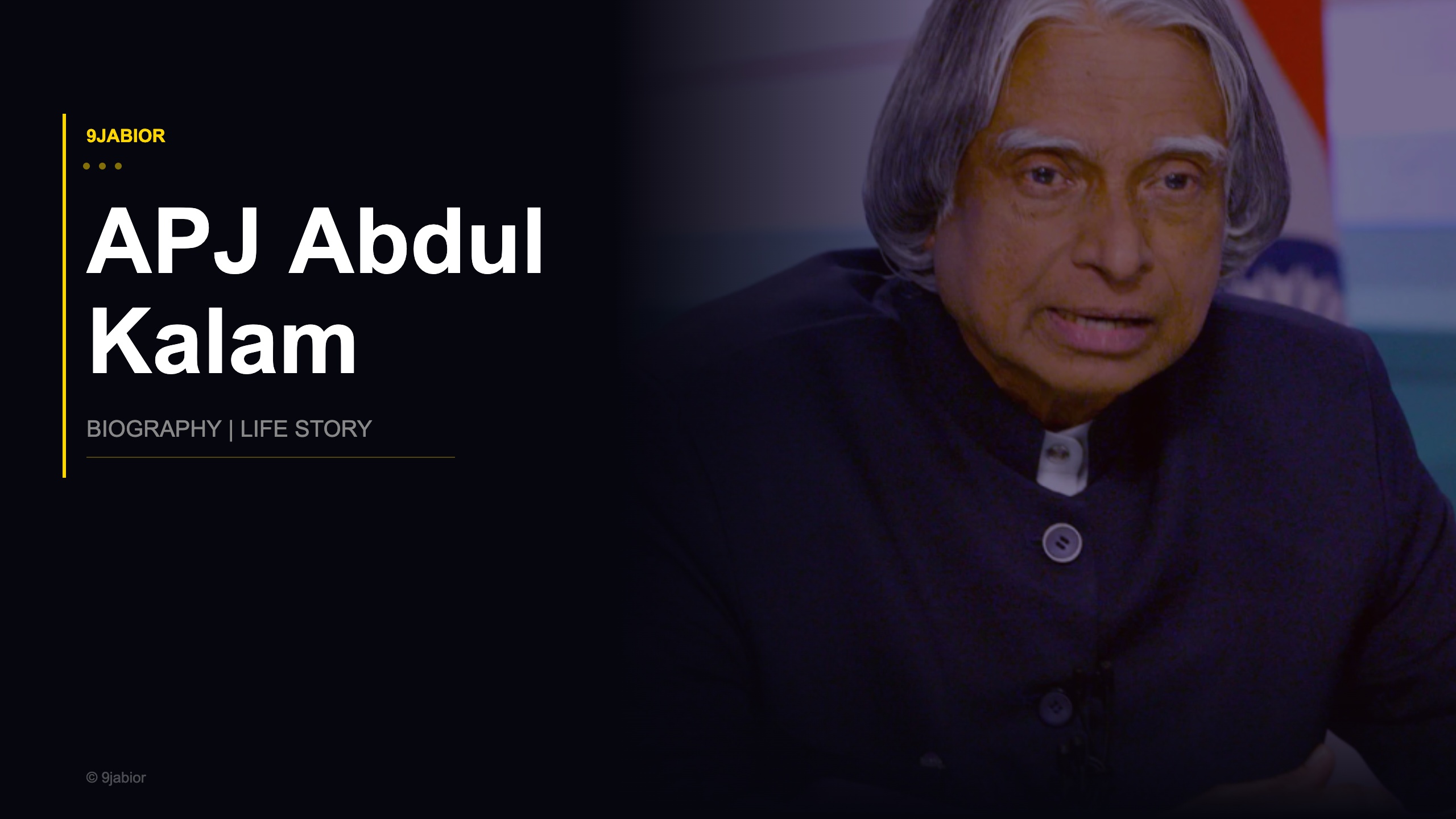
That boy was Avul Pakir Jainulabdeen Abdul Kalam — the man the world would come to know as Dr. APJ Abdul Kalam, the Missile Man of India and the nation’s 11th President. His biography isn’t just a list of dates and achievements. It’s one of the most remarkable human stories of the 20th century — a story of discipline, vision, and an unshakeable belief that ordinary people can accomplish extraordinary things.
If you’ve been searching for a complete biography of APJ Abdul Kalam, you’ve landed in exactly the right place. We’ll go deep — beyond the textbook facts — into who he really was as a person, a scientist, a leader, and a teacher.
Who Was APJ Abdul Kalam? (Quick Overview)
Full Name, Birth, and Vital Facts at a Glance
| Detail | Information |
|---|---|
| Full Name | Avul Pakir Jainulabdeen Abdul Kalam |
| Born | October 15, 1931 |
| Birthplace | Rameswaram, Tamil Nadu, India |
| Died | July 27, 2015 (age 83) |
| Cause of Death | Cardiac arrest during a lecture at IIM Shillong |
| Profession | Aerospace Scientist, Statesman, Author |
| Presidency | 11th President of India (2002–2007) |
| Known As | Missile Man of India, People’s President |
| Key Organisation | DRDO, ISRO |
| Highest Award | Bharat Ratna (1997) |
In one line? APJ Abdul Kalam was a scientist who led India’s missile and nuclear programs, became the country’s most beloved President, and spent his entire life trying to inspire young people to dream bigger than their circumstances.
A Humble Beginning — APJ Abdul Kalam’s Early Life in Rameswaram
The Family That Shaped His Values
Kalam was born on October 15, 1931, in the temple town of Rameswaram in Tamil Nadu. The town sits on a small island off the southeastern coast of India, shaped by religion, simplicity, and the sea. His father, Jainulabdeen, owned a small boat used to ferry Hindu pilgrims across to the Dhanushkodi island. He was also an imam at a local mosque. His mother, Ashiamma, was a homemaker who stretched every rupee with quiet grace.
They weren’t wealthy. Not even close. But the home was rich in something else — values. Jainulabdeen believed in hard work, honesty, and God. He never wasted a word and never showed off. Kalam would say years later that his father’s simplicity left a deeper imprint on him than any degree ever could.
He was the youngest of five siblings. The family lived in an old, modest house in Mosque Street. When finances were tight — which was often — nobody panicked. They just worked harder. That attitude became Kalam’s lifelong default setting.
Selling Newspapers Before Sunrise — Lessons in Hard Work
Here’s something you won’t find in most textbooks. As a young child, Kalam had a paper route. Every morning, before school, he’d help his cousin Samsuddin distribute newspapers to residents and, during World War II, to the tourists and passengers at the Rameswaram railway station when the normal distribution was disrupted.
It wasn’t glamorous. But it funded part of his education. And more importantly, it taught him something about punctuality, reliability, and showing up — lessons that defined his entire professional life.
He never complained about those mornings. In fact, he spoke about them with pride.
The Teacher Who Changed Everything
One of Kalam’s most important early influences was his fifth-grade teacher, Iyadurai Solomon. Solomon noticed young Kalam had a spark — a curiosity that didn’t fit neatly into rote learning. He’d sit with him after class, encourage him to dream with ambition, and famously told him that “to succeed in life and achieve results, you must understand and master three mighty forces — desire, faith, and expectation.”
Those words stayed with Kalam for over seven decades.
The Making of a Scientist — APJ Abdul Kalam’s Education Journey
From Physics in Tiruchirappalli to Aerospace Engineering in Madras
After completing his school education at Schwartz Higher Secondary School in Ramanathapuram, Kalam enrolled at Saint Joseph’s College in Tiruchirappalli. He graduated in 1954 with a degree in physics. He was a solid student — not the prodigy type, but relentless in his effort.
The real turning point came in 1955 when he moved to Madras (now Chennai) and joined the Madras Institute of Technology (MIT) to study aeronautical engineering. This was the moment his career trajectory locked in. At MIT, he discovered his love for aircraft and aerospace systems, spending long hours in the workshops and drawing rooms long after other students had gone home.
He graduated from MIT in 1960 and stepped into the professional world with a degree, a passion for flight, and a head full of ideas.
The Dream of Becoming a Fighter Pilot — and Why It Didn’t Happen
Most people don’t know this part of the story. After graduating, Kalam applied to the Indian Air Force to become a fighter pilot. He desperately wanted to fly. He cleared all the stages and made it to the final selection round.
There were eight openings. He finished ninth.
Ninth. One spot away from his dream.
He was devastated. He went straight to Rishikesh to seek guidance from Swami Sivananda. The Swami’s counsel was simple: your destiny is already mapped out. Don’t fight it — walk it. That quiet acceptance became one of Kalam’s greatest life lessons. He didn’t see failure as a verdict. He saw it as a redirect.
And what a redirect it turned out to be.
Early Career — Walking Into the World of Science
First Days at DRDO — Designing a Hovercraft Nobody Noticed
Kalam joined the Defence Research and Development Organisation (DRDO) in 1958 as a junior scientist. His first assignment? Designing a small hovercraft. It worked. But honestly, he felt the work was too limited for the scale of his ambitions. He wanted to contribute to something that actually mattered at the national level.
He kept showing up, kept delivering, and kept looking for the next door to open.
The Move to ISRO and the SLV-III Project That Changed History
In 1969, that door opened. Kalam transferred to the Indian Space Research Organisation (ISRO) and was appointed Project Director of SLV-III — India’s first indigenous satellite launch vehicle. This was a massive challenge. India didn’t have the technology. It didn’t have the experience. And the international community wasn’t exactly rushing to help.
Kalam built the team. He motivated engineers who’d never done anything like this before. He solved problems on the fly, sometimes pulling all-nighters in the lab.
In July 1980, SLV-III successfully placed the Rohini satellite into orbit. India became a member of an exclusive global club of spacefaring nations. Kalam was 48 years old and had just made history.
The Missile Man Is Born — APJ Abdul Kalam at DRDO’s IGMDP
What Was the Integrated Guided Missile Development Programme?
In 1982, Kalam returned to DRDO as its director. His next mission was the Integrated Guided Missile Development Programme (IGMDP) — an ambitious, home-grown initiative to develop a complete family of guided missiles for India’s defence.
Think of it this way: before IGMDP, India was largely dependent on foreign technology for its defence systems. Kalam’s goal was to change that completely — to build missiles that were entirely Indian, from the drawing board to the launch pad.
The programme produced five major missile systems:
- Agni — a long-range ballistic missile capable of carrying nuclear warheads
- Prithvi — a surface-to-surface tactical missile
- Akash — a surface-to-air air defence missile
- Trishul — a short-range, quick-reaction missile
- Nag — an anti-tank guided missile
This programme didn’t just give India weapons. It gave India the engineers, the processes, the knowledge base, and the confidence to develop advanced defence technology independently. It’s hard to overstate how significant that was.
Agni and Prithvi — Missiles That Put India on the Map
Of all the missiles developed under IGMDP, Agni became the most iconic. The successful test of Agni in 1989 sent a message to the world: India was no longer a passive player in global defence. It was a nation that could protect itself on its own terms.
Kalam didn’t celebrate with champagne or press conferences. He went back to the lab.
Pokhran-II Nuclear Tests 1998 — India’s Boldest Scientific Moment
By 1992, Kalam had become the Principal Scientific Adviser to the Government of India. In this role, he played a decisive part in one of modern India’s most consequential decisions — the Pokhran-II nuclear tests.
In May 1998, five nuclear devices were detonated at the Pokhran test range in Rajasthan. The tests were code-named Operation Shakti. The world reacted with sanctions and condemnation. But inside India, Kalam became a national hero overnight. The tests proved that India had arrived as a nuclear power — not through dependence on anyone else, but through its own scientific muscle.
He was 66 years old and had just helped pull off the defining scientific achievement of independent India.
The Mentors Who Shaped a Legend
Dr. Vikram Sarabhai — The Man Who Believed in Him First
If there’s one person Kalam credited most for his scientific growth, it was Dr. Vikram Sarabhai, the father of India’s space programme. Sarabhai saw in Kalam a rare combination of intellect and commitment. He gave him responsibility early, trusted him with large projects, and created an environment where a young scientist from a small Tamil Nadu town could flourish without the weight of bureaucracy crushing him.
Kalam often said that working under Sarabhai taught him what real leadership looks like — not authority, but inspiration.
Prof. Satish Dhawan and the Culture of Accountability
Kalam also spoke fondly of Prof. Satish Dhawan, his successor at ISRO. In 1979, SLV-III’s first launch attempt failed. Kalam was the project director — the person responsible. He expected public criticism and career consequences.
Instead, Dhawan stood at the press conference and took full responsibility himself. He told reporters that the failure was ISRO’s, not the team’s, and that they would try again.
A year later, when the second launch succeeded spectacularly, Dhawan quietly stepped aside and let Kalam face the cameras alone to receive the credit.
That lesson in accountability and selfless leadership stayed with Kalam forever. He practiced it as a manager, as a scientist, and as a President.
From Scientist to Statesman — APJ Abdul Kalam’s Road to the Presidency
Why Both Ruling and Opposition Parties Backed Him
In 2002, when the ruling National Democratic Alliance (NDA) was looking for a presidential candidate, they chose Kalam. What made this extraordinary wasn’t just that he was a scientist with no political background. It was that the main opposition party — the Indian National Congress — also endorsed him.
That almost never happens in Indian politics. But Kalam had something rare: he belonged to no faction. He was Muslim by faith, deeply Indian at the core, beloved by every demographic. He was the kind of man that nobody could reasonably oppose.
He defeated his opponent in the presidential election with a comfortable margin.
India’s 11th President — A Scientist Enters Rashtrapati Bhavan
On July 25, 2002, Avul Pakir Jainulabdeen Abdul Kalam was sworn in as the 11th President of India. A man who had grown up selling newspapers stepped into the grandest residence in the country.
He didn’t change who he was. He brought his notebooks. His veena. His simple vegetarian diet. His early mornings.
Rashtrapati Bhavan had seen many presidents. It had never seen one quite like this.
What APJ Abdul Kalam Did as President of India (2002–2007)
The 500,000 Student Meetings Goal — A President Like No Other
Most presidents write policy. Kalam wrote letters to schoolchildren. Most presidents give speeches to dignitaries. Kalam sat on the floor with teenagers and talked about their dreams.
He set himself a goal of meeting 500,000 young people across India during his five-year term. Schools, colleges, rural institutes, urban campuses — he went everywhere. He genuinely believed that India’s future was locked inside the potential of its youth, and that unlocking it required someone in power to actually talk to them — not at them.
He came close to achieving that goal.
Technology Vision 2020 — His Blueprint for a Developed India
Even before becoming President, Kalam had crafted a grand idea: Technology Vision 2020. It was a detailed roadmap for transforming India into a developed nation within two decades. The plan focused on five key areas:
- Agriculture and food processing
- Reliable and quality electric power for all
- Education and healthcare
- Information and communication technology
- Critical technologies and strategic industries
As President, he pushed this vision relentlessly — not as abstract policy, but as a practical national conversation. He wanted every young Indian to understand that their personal success and the nation’s success were the same story.
How He Refused Presidential Perks and Lived Simply
Here’s a detail that says everything about the man. As President, Kalam had access to luxury vehicles, helicopters, elaborate state accommodations, and a full retinue of assistants. He used what was necessary for official duties and nothing more. His personal quarters were famously sparse. He kept books, musical instruments, and very little else.
He reportedly refused to use the official presidential helicopter for personal travel whenever a commercial option was available. The staff at Rashtrapati Bhavan, from secretaries to housekeeping teams, often said he was the most humble president they had ever served.
Life Beyond the Lab and the Bhavan — APJ Abdul Kalam’s Personal World
A Man Who Never Married and Why He Chose That Life
APJ Abdul Kalam never married. He never publicly explained this choice in great detail, but those close to him understood it as a deliberate decision. He had committed himself completely to his work and his country. A family, he seemed to feel, might divide that commitment — and Kalam didn’t do things in halves.
He showered his warmth instead on millions of young people across India. In a very real sense, the youth of India were his family.
His Love for the Veena, Poetry, and Tamil Literature
This is the side of Kalam that most bios skip entirely, and it’s one of the most interesting things about him. He played the veena — a classical South Indian string instrument — with genuine skill. He wrote poetry in Tamil. He loved literature and often quoted from ancient Tamil texts, particularly Thirukkural.
He wasn’t just a scientist. He was a complete person — someone who found beauty in both equations and verses, in both rocket trajectories and musical notes. That wholeness was part of what made him such a compelling human being.
Faith Across Religions — Reading the Quran and the Bhagavad Gita
Kalam was Muslim by birth and practice. He read the Quran daily. But he also studied Hindu scriptures, read the Bhagavad Gita, and learned Sanskrit. He saw no contradiction in this. For him, spirituality was about connecting with something larger than yourself — and every genuine tradition pointed in that direction.
This interfaith sensibility wasn’t performative. It was real. And it made him a symbol of India’s most powerful idea: that diversity isn’t a problem to be managed, it’s a strength to be celebrated.
Shashi Tharoor described him beautifully as “a complete Indian — an embodiment of the eclecticism of India’s heritage of diversity.”
Books Written by APJ Abdul Kalam — Ideas That Live On
Wings of Fire — The Autobiography That Inspired a Generation
Published in 1999, Wings of Fire is the book that made millions of Indians feel like their dreams were legitimate. It traces Kalam’s journey from the narrow lanes of Rameswaram to the cutting edge of India’s space and defence programmes. It’s part autobiography, part love letter to science, part meditation on what it means to serve your nation.
What makes it powerful isn’t just the story — it’s the honesty. Kalam writes about failure, doubt, and the moments when he wasn’t sure he’d make it. He wrote it so that anyone reading it — no matter their background — could see themselves in him.
Ignited Minds, India 2020, and Other Must-Reads
Beyond Wings of Fire, Kalam authored more than 25 books. Some of the most impactful include:
- Ignited Minds (2002) — a call to India’s youth to dream boldly and take ownership of the nation’s future
- India 2020 (1998) — co-written with Y.S. Rajan, outlining the Vision 2020 framework
- My Journey (2013) — a later autobiography tracing the arc of his life in reflective detail
- Transcendence (2015) — his final book, co-authored with Arun Tiwari, exploring his spiritual outlook
These aren’t just motivational books. They’re practical, honest, and deeply thought-through. They’ve been translated into dozens of languages and remain widely read today.
Awards and Recognitions — A Nation’s Gratitude
India’s government didn’t wait until Kalam was gone to recognise him. He received every major civilian award the country could give:
- Padma Bhushan (1981) — for distinguished service of a high order
- Padma Vibhushan (1990) — for exceptional and distinguished service
- Bharat Ratna (1997) — India’s highest civilian honour, awarded for his contributions to science, engineering, and national service
He also received honorary doctorates from more than 40 universities around the world — a remarkable number for someone who spent most of his life in a lab rather than a lecture hall.
After the Presidency — APJ Abdul Kalam’s Life from 2007 to 2015
Teaching, Mentoring, and Refusing to Slow Down
When Kalam’s presidential term ended in July 2007, most people expected him to retire quietly. He was 75 years old, after all. He had already done more than most people do in three lifetimes.
Instead, he went back to teaching.
He took up positions at multiple universities — IIM Ahmedabad, IIM Indore, Anna University, and others. He kept writing. He kept giving lectures. He kept meeting students. He kept answering letters from young people who wrote to him seeking guidance on their dreams and careers.
Between 2007 and 2015, he crisscrossed India with an energy that embarrassed people half his age. He wasn’t preserving his legacy. He was still building it.
The Final Lecture — How APJ Abdul Kalam Died
July 27, 2015 — Passing Away While Doing What He Loved
On July 27, 2015, Abdul Kalam flew to Shillong to deliver a lecture at the Indian Institute of Management Shillong. The topic was “Creating a Liveable Planet Earth.” He was 83 years old and had been unwell in the preceding weeks, but he insisted on going.
He walked up to the podium. He began speaking. About five minutes into his lecture, he collapsed.
He was rushed to Bethany Hospital, where doctors worked for hours. But the cardiac arrest was too severe. At 7:45 PM, India’s most beloved scientist and former President was declared dead.
He died with his shoes on, mid-sentence, doing exactly what he’d spent his entire life doing — talking to young people about tomorrow.
His body was flown to Rameswaram, where he was buried with full state honours on July 30, 2015. More than 350,000 people lined the streets to pay their respects.
The Legacy of APJ Abdul Kalam — Why He Still Matters in 2025
Schools, Awards, and Youth Renaissance Day in His Name
Since his death, Kalam’s memory has been honoured in tangible, lasting ways. The Tamil Nadu government established the Dr. A.P.J. Abdul Kalam Award to recognise exceptional contributions to science and education. October 15 — his birthday — was declared Youth Renaissance Day in Tamil Nadu. Numerous schools, universities, roads, and research institutions across India have been named after him.
In 2015, the United Nations also declared October 15 as World Students’ Day in his honour — recognising his lifetime of engagement with young learners.
Lessons From His Life That Every Young Person Should Know
Here’s what makes the biography of APJ Abdul Kalam truly worth reading — not just as history, but as a living manual for life:
- Failure is not a full stop. He failed to become a pilot. That failure became the starting line for everything else.
- Your background doesn’t determine your ceiling. He sold newspapers as a kid and became India’s President. That’s not a motivational poster — it actually happened.
- Stay curious across disciplines. He was a scientist who played veena and wrote poetry. Depth in one field doesn’t require shallowness in all others.
- Serve without showing off. He had access to helicopters and luxury and chose simplicity every single time.
- Keep going. He was still delivering lectures at 83. The work doesn’t stop until you do.
In a world that often rewards loudness and self-promotion, Kalam’s quiet, purposeful life stands as a powerful counterpoint. He didn’t go viral. He went deep. And the depth is why, more than a decade after his death, people still read his books, quote his words, and name their children after him.
Frequently Asked Questions About APJ Abdul Kalam
What is APJ Abdul Kalam’s full name? His full name was Avul Pakir Jainulabdeen Abdul Kalam. He was born into a Tamil Muslim family in Rameswaram, Tamil Nadu, on October 15, 1931.
Why is APJ Abdul Kalam called the Missile Man of India? He earned this title because of his central role in developing India’s first indigenous guided missiles through the Integrated Guided Missile Development Programme (IGMDP) at DRDO. Under his leadership, India developed the Agni, Prithvi, Akash, Trishul, and Nag missile systems, giving India genuine defence self-sufficiency.
Was APJ Abdul Kalam ever married? No, APJ Abdul Kalam never married. He chose to dedicate his life fully to his work and his country. He channelled his personal warmth into his relationship with millions of young Indians, whom he mentored and inspired throughout his life.
What was APJ Abdul Kalam’s most famous book? Wings of Fire (1999) is his most celebrated work — an autobiography that traces his journey from Rameswaram to the heights of Indian science. It has been translated into numerous languages and remains widely read by students and professionals across the world.
What did APJ Abdul Kalam do after his presidency ended? After his presidential term ended in 2007, Kalam returned to teaching and public engagement. He took up visiting professorships at several leading institutions including IIM Ahmedabad and Anna University, continued writing books, and kept travelling across India to meet and inspire young people right up until his death in 2015.
How did APJ Abdul Kalam die? On July 27, 2015, Kalam suffered a cardiac arrest while delivering a lecture at the Indian Institute of Management (IIM) Shillong. He was rushed to hospital but could not be revived. He was 83 years old.
What is APJ Abdul Kalam’s contribution to India’s nuclear programme? Kalam played a critical coordination and leadership role in the Pokhran-II nuclear tests in May 1998, known as Operation Shakti. He served as the Principal Scientific Adviser to the Government and helped India achieve the status of a full nuclear power.
What is Technology Vision 2020? Technology Vision 2020 was Kalam’s strategic plan to transform India into a developed nation by the year 2020 through targeted investment in agriculture, healthcare, education, infrastructure, and critical technologies. He developed it in 1998 and promoted it throughout his presidency and beyond.

 Ghost Blogger