 Ghost Blogger
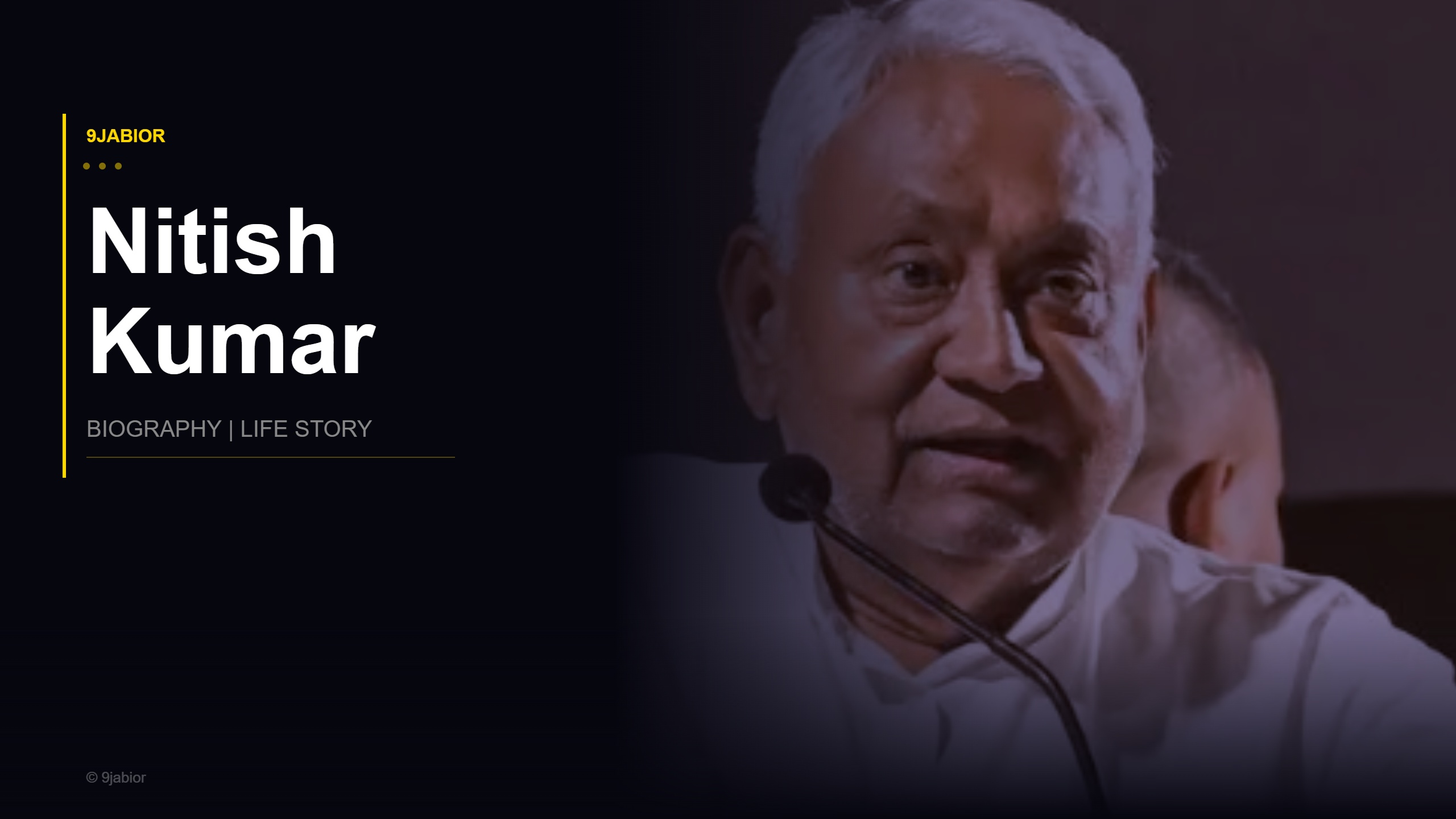
There’s a phrase that follows Nitish Kumar everywhere — Sushashan Babu. Translated loosely, it means “Mr. Good Governance.” For a state that was once described as India’s most lawless, most underdeveloped, most ungovernable — a state where kidnapping was practically a cottage industry and roads were a distant dream — that nickname meant everything.
Nitish Kumar is one of the most complex political figures modern India has produced. He’s an engineer who never wanted to be an engineer. A socialist who governed with the BJP. A man who claimed to hate political dynasties, only to watch his own son enter the party the moment he stepped down. He’s been called Bihar’s savior, a flip-flopper, a reformer, a survivor, and a paradox — often in the same breath.
This is the complete Nitish Kumar biography — from a small town in Bihar to ten terms as Chief Minister, and finally to the Rajya Sabha in 2026.
Quick Facts About Nitish Kumar
- Full Name: Nitish Kumar
- Date of Birth: March 1, 1951
- Place of Birth: Bakhtiarpur, Patna district, Bihar
- Caste: Kurmi (OBC)
- Nickname: Munna; Sushashan Babu
- Education: B.Sc. Engineering (Electrical), Bihar College of Engineering (NIT Patna), 1972
- Wife: Manju Kumari Sinha (married 1973, died 2007)
- Son: Nishant Kumar
- Party: Janata Dal (United) — JDU
- Positions Held: Chief Minister of Bihar (10 terms), Union Minister for Railways, Agriculture, Surface Transport
- Chief Minister Terms: 2000 (7 days), 2005–2014, 2015–2017, 2017–2022, 2022–2024, 2024–2026
- Current Role (2026): Member of Parliament, Rajya Sabha
Early Life and Childhood in Bakhtiarpur
Nitish Kumar was born on March 1, 1951, in Bakhtiarpur — a small town roughly 50 kilometres from Patna, Bihar’s capital. It wasn’t the kind of place that produced national politicians. It was dusty, modest, and far from the corridors of power. But it gave Nitish something that no engineering college ever could: a front-row seat to the politics of poverty and injustice.
A Father Who Shaped His Political Conscience
His father, Kaviraj Ram Lakhan Singh, was a well-known Ayurvedic practitioner in the area. But he was more than a healer — he was a man with a political spine. Before independence, Kaviraj Ram had volunteered with the Indian National Congress and participated in the freedom movement. After independence, he twice tried to contest the Vidhan Sabha elections — in 1952 and 1957 — but was denied the opportunity by the party. Frustrated, he eventually joined the Janata Party.
Growing up watching his father fight for political space despite clear qualifications shaped young Nitish deeply. He absorbed the idea that the system could be resistant to good people, and that changing it required persistence rather than submission.
Schooling and the Roots of a Rebel Mind
Nitish completed his schooling at Ganesh High School in Bakhtiarpur. After matriculation, he moved to Patna and enrolled at Patna Science College. He was bright, curious, and politically aware from an early age — the kind of student who paid as much attention to student union debates as to classroom lectures.
Education: From Engineering to Politics
Life at Bihar College of Engineering
After completing his intermediate education, Nitish Kumar secured admission at the prestigious Bihar College of Engineering in Patna — now known as the National Institute of Technology (NIT Patna). He graduated with a degree in Electrical Engineering in 1972.
It’s worth noting: he was genuinely smart. Engineering at one of Bihar’s top institutions wasn’t a participation trophy. It required discipline and academic ability. But engineering, as it turned out, was never his calling.
The Job He Never Wanted
After graduating, Nitish joined the Bihar State Electricity Board — the government engineering job that every parent in Bihar dreamed of for their son. He lasted there briefly. The work didn’t excite him. What did excite him was politics. He quit and never looked back. The Electricity Board’s loss was Bihar’s eventual gain.
Personal Life: Family, Marriage, and Quiet Tragedy
The Anti-Dowry Stand That Defined His Character
Here’s a story that very few biography pages bother to mention — and it says more about Nitish Kumar than any of his policy achievements do.
When his wedding was arranged with Manju Kumari Sinha in 1973, it reportedly came with a dowry of Rs. 22,000 — not an unusual practice in Bihar at the time. But when Nitish found out, he was furious. He demanded the money be returned immediately. For a young man from a small town in 1970s Bihar, that wasn’t just an ethical stance. It was a social statement, and a risky one at that.
It tells you something about who he was before politics shaped him.
Wife Manju Kumari Sinha and Son Nishant
Nitish Kumar and Manju Kumari Sinha were married on February 22, 1973. Manju was a teacher by profession. Together they had one son, Nishant Kumar, who later graduated from Birla Institute of Technology (BIT), Mesra.
Manju Sinha passed away on May 14, 2007, in New Delhi, due to pneumonia. She was 53 years old. Nitish Kumar never remarried. He’s widely known for keeping his family life extremely private — deliberately so. His son Nishant stayed away from politics for decades, a deliberate choice that Nitish often defended as a stance against political dynasties. That stance would later crumble under its own weight, but more on that later.
Political Awakening: The JP Movement and Early Career
Nitish Kumar didn’t just stumble into politics. He was drawn into it through one of India’s most electric political moments — the Jayaprakash Narayan Movement of 1974–1977.
JP, as Narayan was known, led a mass uprising against the Indira Gandhi government’s corruption and authoritarian tendencies. Young Nitish was completely swept up in it. He became a notable youth leader during this period, participating actively in protests and mobilising students. In 1975, during the Emergency declared by Indira Gandhi, he was arrested and detained under the Maintenance of Internal Security Act (MISA). That brush with state power didn’t intimidate him — it galvanized him.
After the Emergency ended, he joined the Janata Party led by Satyendra Narain Sinha. His political mentors during these formative years read like a who’s who of Indian socialist politics: Ram Manohar Lohia, S.N. Sinha, Karpuri Thakur, George Fernandes, and V.P. Singh.
Rising Through the Janata Dal
Nitish made his first serious attempt at electoral politics in the early 1980s and failed — twice. But in 1985, he won a seat in the Bihar Legislative Assembly as an independent candidate. It was his breakthrough moment, and he never let go after that.
He was nominated as President of the Yuva Lok Dal, the youth wing of the Bharatiya Lok Dal, and was later chosen as Secretary General of the Janata Dal in the state. In 1989, he entered the 9th Lok Sabha, representing Barh constituency. That same year, he became Union Minister of State for Agriculture in the V.P. Singh government.
He re-won Parliament in 1991. By this point, he’d positioned himself as one of the important younger voices of Indian socialist politics — serious, focused, and notably less flamboyant than many of his peers.
Formation of the Samata Party
By 1994, tensions within the Janata Dal had become unmanageable. Lalu Prasad Yadav’s Rashtriya Janata Dal was pulling the party in one direction while Nitish saw a different path. Together with the veteran George Fernandes, Nitish Kumar broke away and founded the Samata Party in 1994.
The Samata Party eventually aligned with the BJP-led National Democratic Alliance (NDA), a choice that would define — and complicate — much of Nitish’s future career. In 1998, during the Atal Bihari Vajpayee government, Kumar and the NDA won the election and Nitish was elevated to the Union Cabinet.
Central Government Years: Railways, Agriculture, and a Moral Resignation
Between 1996 and 2004, Nitish Kumar served as a Union Cabinet Minister across multiple portfolios under Prime Minister Atal Bihari Vajpayee. His tenures included:
- Union Cabinet Minister for Railways (1998–1999, 2001–2004)
- Union Cabinet Minister for Surface Transport (1998–1999)
- Union Cabinet Minister for Agriculture (1998–1999)
As Railways Minister, he introduced significant reforms — including the internal ticket booking system in 2002 and the Tatkal scheme. He also championed “Kisan Special” trains to help farmers transport crops more efficiently.
The Gaisal Train Accident — A Defining Moment
On August 2, 1999, one of India’s worst rail disasters occurred when two trains collided near Gaisal in West Bengal, killing hundreds of passengers. As the sitting Railways Minister, Nitish Kumar did something that almost no Indian politician does voluntarily: he resigned, accepting moral responsibility for the accident.
He wasn’t found legally culpable. The disaster happened on his watch, and he chose to step down anyway. That single act of accountability, rare as a solar eclipse in Indian politics, earned him enormous respect and set a benchmark that would define his public image for years to come. He returned to the Railways portfolio in 2001 and continued his reform agenda.
Chief Minister of Bihar: Rescuing a State from Jungle Raj
To understand what Nitish Kumar achieved as Chief Minister, you first have to understand what Bihar looked like before him. The 1990s and early 2000s in Bihar were defined by what critics called “Jungle Raj” — a period of governance collapse under Lalu Prasad Yadav’s tenure. Criminal gangs operated with near-complete impunity. Kidnapping for ransom was rampant. Roads were in ruins. The state’s economy was stagnant, and educated professionals were fleeing as fast as they could.
The First Brief Term (2000) and the Long Wait
In March 2000, during a brief political realignment, Nitish Kumar was sworn in as Chief Minister of Bihar for the first time. He lasted exactly seven days. He couldn’t prove his majority on the floor of the House, and the government collapsed.
But he was patient. He spent the next five years building his position, waiting for the opportunity to govern properly.
The 2005 Breakthrough: Sushashan Babu Takes Charge
The 2005 Bihar Assembly elections changed everything. The NDA — with JDU and BJP as partners — won the majority, and on November 24, 2005, Nitish Kumar was sworn in as Chief Minister with Sushil Kumar Modi as his deputy. He would hold this position continuously until May 2014 — nine years in which Bihar underwent a remarkable transformation.
The nickname Sushashan Babu wasn’t handed to him. He earned it, brick by brick, conviction by conviction.
Law and Order Revolution
His first target was the most urgent one: bringing law and order back to a state that had almost given up on it.
He introduced the Special Vigilance Unit (SVU) to investigate high-level corruption cases. Former Director General of Police Narayan Mishra was successfully prosecuted in 2007 — a signal that no one was above accountability. Nitish reformed the police recruitment process, implemented a “Carbon Copy system” in written examinations to prevent interference, and formed the Special Auxiliary Police (SAP) — a force made up of retired military personnel tasked with tackling Maoist insurgency in Bihar’s backward regions.
He established an Anti-Terrorist Squad after the 2013 Bodhgaya blasts and empowered the Extremely Backward Castes (EBCs) through political representation and targeted reservation policies.
The results were visible. Bihar’s crime statistics began to decline. Kidnapping rings were dismantled. Citizens in Patna started feeling safe enough to venture out at night.
The Saat Nischay Schemes and Women Empowerment
One of Nitish Kumar’s most important governance signatures was the Saat Nischay (Seven Resolves) programme — a set of seven flagship welfare commitments that included access to electricity for every household, tap water, paved roads, employment for the youth, toilets in homes, higher education for girls, and broadband connectivity. The programme was introduced in 2015–16 and later expanded.
He appointed more than 100,000 school teachers, reduced female illiteracy by nearly half, and ensured that doctors were present and working at primary health centres — something that had been a chronic failure in Bihar for decades.
The bicycle scheme for girls who stayed in school was particularly effective. Thousands of girls who previously dropped out because they couldn’t reach their schools now had reliable transport. Enrollment numbers rose sharply. It wasn’t glamorous policy — it was practical, targeted, and it worked.
He also gave women 50 percent reservation in Panchayati Raj institutions — a structural change in local governance that put women in decision-making positions at the grassroots level.
The Alliance Shuffle: Bihar’s Most Unpredictable Politician
If Nitish Kumar’s governance record reads like a success story, his political journey reads like a thriller. Few Indian politicians have changed alliances as frequently — and survived as comfortably — as he has.
Splitting with BJP (2013), Reuniting, Splitting Again
In 2013, Kumar broke his long-standing alliance with the BJP over the elevation of Narendra Modi as its campaign figure. He resigned from the NDA, calling Modi’s rise incompatible with his secular commitments.
He allied with the RJD and Congress for the 2015 Bihar elections — and won convincingly, forming the Grand Alliance (Mahagathbandhan). In 2017, however, he reversed course again. When corruption charges were filed against Deputy CM Tejashwi Yadav (Lalu Prasad’s son) and the RJD refused to act, Nitish resigned from the Mahagathbandhan. He walked out, crossed the floor, and within 24 hours had rejoined the NDA and was sworn in as Chief Minister again.
Critics dubbed him Paltu Ram — a Hindi phrase meaning “one who keeps turning.” His supporters argued he was simply refusing to tolerate corruption. The debate continues.
The INDIA Alliance and National Ambitions
Between 2022 and 2024, Nitish Kumar once again broke with the BJP and rejoined the Mahagathbandhan. This time, he played a prominent national role in forming the INDIA (Indian National Developmental Inclusive Alliance) — a coalition of opposition parties seeking to challenge the BJP at the 2024 general elections. He was briefly spoken of as a potential consensus candidate for Prime Minister.
Then, on January 28, 2024, he switched sides again — resigned from the Mahagathbandhan, rejoined the NDA, and was sworn in as Chief Minister for the ninth time.
Ninth and Tenth Term — Historic Milestones
In the Bihar Assembly elections of November 2025, the NDA under Nitish Kumar won in a landslide — 202 out of 243 seats. On November 20, 2025, he was sworn in as Chief Minister for a historic tenth time at Gandhi Maidan in Patna, with Prime Minister Narendra Modi and Home Minister Amit Shah attending the ceremony. It was an extraordinary record — no other Chief Minister in Bihar’s history had served more terms.
Major Achievements and Development Legacy
Liquor Ban — Bold or Costly?
In 2016, Nitish Kumar announced a total prohibition on alcohol in Bihar — one of the most sweeping and controversial policy moves of his tenure. He officially implemented the ban on April 5, 2016. Violating the law carries a penalty of five to ten years in prison.
The ban was massively popular with women’s groups, who argued that male alcohol consumption was closely linked to domestic violence and financial ruin in poor households. Kumar positioned himself as a champion of women and families.
Critics, however, noted that the ban cost Bihar approximately Rs. 28,000 to 30,000 crore annually in lost revenue — a significant blow for a state that already had one of the smallest revenue bases in India. The ban also gave rise to an illegal liquor trade, a parallel economy, and the mass arrest of thousands of poor citizens caught with small quantities of country liquor.
It remains the most debated legacy of his time in office.
Girls’ Education and Cycle Scheme
The cycle scheme for girls remains one of his most universally praised initiatives. By offering free bicycles to girls who stayed enrolled in schools, the government addressed one of the simplest and most overlooked barriers to female education — distance. The scheme resulted in a measurable spike in female school enrollment and a significant reduction in dropout rates.
Bihar’s Economic Growth Under His Watch
Bihar’s GDP grew at rates exceeding the national average for several years during Nitish Kumar’s tenure. Public investment in roads, bridges, electricity, and schools created both infrastructure and jobs. The state’s image in national perception shifted from “failing state” to “transforming state.” However, critics rightly point out that industrial growth and private investment remained limited. Bihar continued to export labour — millions of migrant workers left the state for jobs in other parts of India, a fact that Nitish Kumar’s critics see as the most glaring hole in his development narrative.
Controversies That Followed Nitish Kumar
The “Paltu Ram” Tag
By 2026, Nitish Kumar had changed political alliances at least six times in thirteen years. The joke in Bihar was that you needed a scorecard to track which side he was on at any given moment. While his defenders argue each shift was principled — a response to corruption or betrayal — even sympathetic analysts acknowledge that the pattern eroded trust in his political commitments and raised genuine questions about whether power, not principle, was the constant in his calculations.
The 2023 Remarks on Women’s Education
In November 2023, Nitish Kumar made remarks during a Bihar Assembly session about women’s education and population control that were widely condemned as crass and offensive. The remarks led to protests from women’s organizations, political opponents, and public outrage. Even Prime Minister Modi criticized the comments. Nitish Kumar issued an apology, retracted the statements, and reaffirmed his record on women’s empowerment. The episode was a significant public relations setback and highlighted the gap between his policy record and certain cultural attitudes.
Awards and Recognitions
Over his career, Nitish Kumar has received recognition across a range of platforms:
- Best Chief Minister in India — CNN-IBN and Hindustan Times State of the Nation Poll (2007)
- NDTV Indian of the Year (Politics) — 2009 and 2010
- “Indian of the Year” (Politics) — CNN-IBN (2010)
- “India’s Person of the Year” — Forbes India (2010)
- “Business Reformer of the Year” — Economic Times (2009)
- “Great Indian of the Year” (Politics) — CNN-IBN (2008)
- “Sir Jehangir Gandhi Medal” by XLRI, Jamshedpur — for Industrial and Social Peace (2011)
- Ranked 77th among the Top 100 Global Thinkers — Foreign Policy Magazine (2012)
- JP Memorial Award — Nagpur’s Manav Mandir (2013)
- Anuvrat Puraskar — Shwetambar Terapanthi Mahasabha (Jain organization), for enforcing total prohibition on liquor in Bihar (2017)
- “Polio Eradication Championship Award” — Rotary International (2009)
Nitish Kumar’s Net Worth and Assets
Nitish Kumar is famous for his modest declared assets, especially unusual given his more than two decades in high public office. According to official affidavit data, his declared movable and immovable assets are approximately Rs. 3 crore — making him one of the least wealthy among senior politicians of his standing.
His declared assets include a 1,000 sq ft apartment in Delhi’s Dwarka neighborhood (purchased in 2004 for around Rs. 13.78 lakh), modest bank deposits, jewellery valued at Rs. 1.28 lakh, and — in a charming detail that made headlines — 13 cows and 10 calves valued at Rs. 1.45 lakh.
His salary as Chief Minister was approximately Rs. 2.15 lakh per month (around Rs. 25.8 lakh per year). The modest declared wealth has consistently been cited as evidence of his personal integrity, even by political opponents who criticize his governance choices.
Books Written About Nitish Kumar
Two notable biographies have been written about Nitish Kumar’s life and political career:
“Single Man: The Life And Times of Nitish Kumar of Bihar” by Sankarshan Thakur — a detailed account of his personal and political journey, written with journalistic depth.
“Nitish Kumar and The Rise of Bihar” by Arun Sinha — a more focused examination of how Kumar transformed Bihar’s governance and development landscape.
Both books are worthwhile reading for anyone wanting to understand the man beyond the newspaper headlines.
The 2026 Transition: From Chief Minister to Rajya Sabha
In March 2026, Nitish Kumar made a surprising announcement: he would resign as Chief Minister and contest the upcoming Rajya Sabha elections. After winning the seat, he was sworn in as Member of Parliament, Rajya Sabha, on April 10, 2026 — the birth anniversary of B.R. Ambedkar, a date chosen with deliberate symbolism.
The move marked the end of an era. Bihar’s longest-serving Chief Minister, holder of the office for 10 terms and more than 19 years in total, transitioned from state executive power to the national legislature.
The new Chief Minister of Bihar is BJP’s Samrat Chaudhary — marking the first time since 2005 that a non-JDU figure occupies the top seat in Patna.
Nishant Kumar Joins JDU — Anti-Dynasticism Ends?
Shortly after Nitish announced his resignation, his son Nishant Kumar — who had stayed away from politics for decades — formally joined the JDU. The move drew immediate commentary. Nitish had long positioned himself as someone who stood against dynastic politics. His decision not to actively promote his son had been cited for years as a mark of his democratic integrity. Nishant’s entry into the party within days of his father’s departure raised questions about whether the principled stand was a genuine belief or a political posture maintained as long as it served a purpose.
Nitish Kumar’s Legacy — What History Will Say
There are two versions of Nitish Kumar’s legacy, and both are true.
The first version is the one Bihar’s women, teachers, and commuters know. Roads that actually exist. Schools with actual teachers. A state where kidnapping for ransom no longer features in daily news bulletins. A generation of girls who finished secondary school because a government gave them a bicycle. This is the version that earned him the Sushashan Babu title and that ten different election victories ultimately validated.
The second version is the one Bihar’s migrant workers know — those millions who still leave the state every year seeking work in Surat, Mumbai, and Punjab. Bihar grew economically under Nitish Kumar, but it never industrialised. Jobs were created in government and construction, but the private sector never arrived in the numbers required. For them, the Bihar of 2026 is better than the Bihar of 2005, but it hasn’t become the Bihar they’d choose to stay in.
The alliance shifts — the six coalition changes in thirteen years — will be a permanent feature of his political obituary. Whether history calls them principled or opportunistic depends entirely on whose story you believe.
What’s certain is that Nitish Kumar reshaped Bihar in ways that were not inevitable. A different leader with a different set of priorities might have allowed the state to stay exactly where it was in 2005: broken, violent, and forgotten. He didn’t. For that, whatever else is said about him, he deserves his place in history.
Frequently Asked Questions About Nitish Kumar
What is Nitish Kumar’s date of birth and age? Nitish Kumar was born on March 1, 1951, in Bakhtiarpur, Patna district, Bihar. As of 2026, he is 75 years old.
How many times has Nitish Kumar been Chief Minister of Bihar? Nitish Kumar has been sworn in as Chief Minister of Bihar ten times. His total tenure spans over 19 years, making him Bihar’s longest-serving Chief Minister in history.
What is Nitish Kumar’s caste? Nitish Kumar belongs to the Kurmi agricultural caste, which falls under the Other Backward Classes (OBC) category in Bihar.
What is Nitish Kumar’s educational qualification? He holds a B.Sc. in Electrical Engineering from Bihar College of Engineering, Patna (now NIT Patna), which he completed in 1972.
Who was Nitish Kumar’s wife? Nitish Kumar was married to Manju Kumari Sinha on February 22, 1973. She was a schoolteacher by profession. Manju Sinha passed away on May 14, 2007, due to pneumonia. They had one son, Nishant Kumar.
Why is Nitish Kumar called Sushashan Babu? “Sushashan Babu” means “Mr. Good Governance” in Hindi. The nickname was given to Nitish Kumar after he transformed Bihar’s law and order situation, infrastructure, and administration following his 2005 election victory. Bihar had previously experienced what critics called “Jungle Raj,” and his tenure marked a dramatic improvement in governance.
What is Nitish Kumar’s net worth? Based on officially declared affidavit data, Nitish Kumar’s total declared assets are approximately Rs. 3 crore — a relatively modest figure for a politician who served as Chief Minister for over 19 years.
What happened in the Gaisal train accident involving Nitish Kumar? On August 2, 1999, two passenger trains collided near Gaisal station in West Bengal, resulting in hundreds of deaths. Nitish Kumar was the Union Railways Minister at the time. Although he was not found legally responsible, he resigned accepting moral accountability — a gesture widely praised as exceptional in Indian politics.

 Ghost Blogger